A Litmus Test of Ankara’s Middle-Power Role: Why Turkey Must Choose Between Patronage and Peacemaking
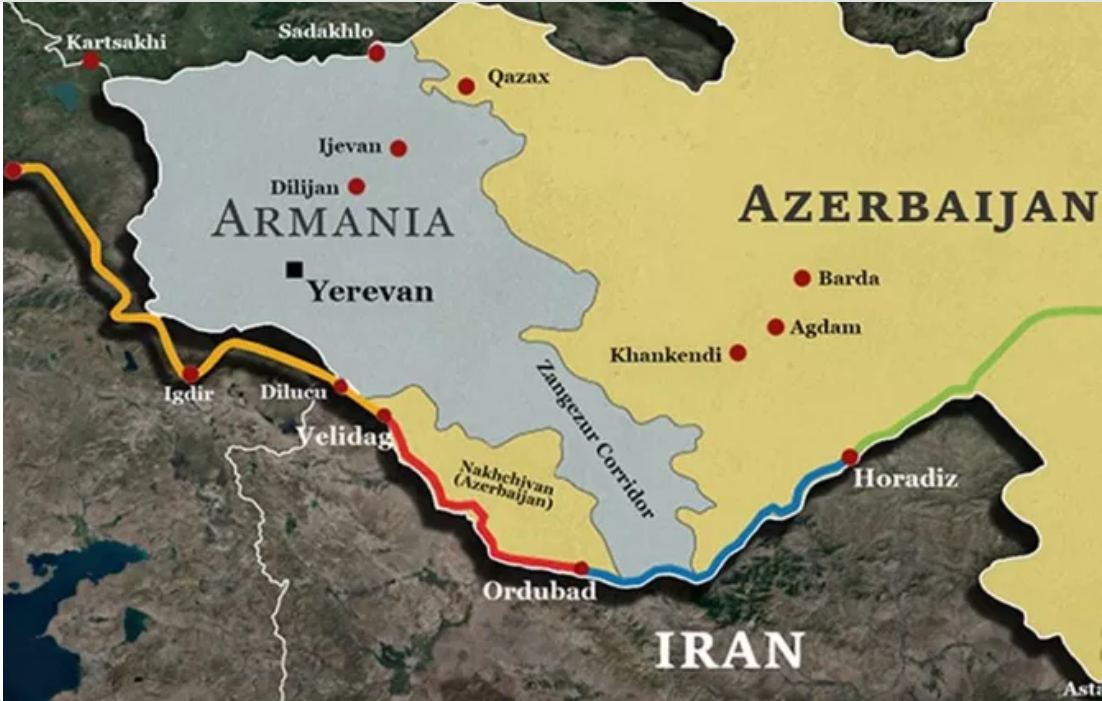 zengezur koridoru
The August 2025 Washington summit between the leaders of Armenia and Azerbaijan marked a critical inflection point for the South Caucasus, establishing a path toward regional connectivity grounded in international norms. Yet, the summit’s most significant revelation was not the content of the peace accord, but rather Turkey’s noticeable absence from the negotiation table. Despite its geopolitical importance and capacity to act as a regional anchor, Ankara played no part in shaping the parameters of the deal, exposing a crucial tension between Turkey’s foreign policy aspirations as a middle power and its self-imposed strategic constraints.
The resulting agreement, quickly dubbed the Trump Route for International Peace and Prosperity (TRIPP), created a framework for reopening regional transportation routes based on reciprocity and explicit respect for sovereignty and territorial integrity. This means connectivity between Azerbaijan’s mainland and the Nakhchivan exclave via Armenia is balanced by enhanced international and domestic connectivity for Armenia through Azerbaijan.
Crucially, the Washington accord directly challenges the previous, highly polarizing approach of a coercive, extraterritorial “Zangezur Corridor”—a concept long pushed by Baku and Moscow, often with Ankara’s vocal backing. By prioritizing mutual acceptance of established territorial borders, the agreement reinforces the most common mechanism for preventing armed conflict globally and seeks to fully integrate the South Caucasus into global economic and trade networks.
Ankara’s Cautious Response and the Reversion to Revisionism
Following the Washington success, there were initial, tangible steps toward normalization between Turkey and Armenia. Turkey’s special envoy crossed the two countries’ decades-closed land border for diplomatic talks in Yerevan, and Turkish Airlines announced plans for service to Armenia. However, this promising momentum quickly dissipated as Ankara failed to capitalize on the diplomatic opening with a bold, proactive policy.
While Turkey officially welcomed the Washington agreement, official statements and diplomatic language swiftly reverted to familiar, narrowly framed nationalist rhetoric. Turkish officials, including the Minister of Transportation and Infrastructure, continued to use the language of “corridors,” announcing the intended completion of the Zangezur Corridor with an extension to Turkey to enhance connectivity across the “Turkic world.” This insistence on revisionist terminology fundamentally contradicts the reciprocal, rules-based principles of the TRIPP deal, which specifically reject the notion of an extraterritorial, rights-violating corridor.
This linguistic and diplomatic self-sabotage suggests that Ankara may be deferring once again to Azerbaijan’s maximalist demands. Baku’s increasingly complicated preconditions for signing a final peace treaty—such as insistence on constitutional amendments in Armenia—are testing the limits of the Washington accord. By mirroring Baku’s language, Turkish officials risk painting Ankara as a partisan actor rather than a neutral, stabilizing force, diminishing its credibility in the eyes of the international community and Yerevan.
The Strategic Cost of Self-Restraint: Losing Middle-Power Stature
The most critical strategic cost of Turkey’s current approach is its inability to translate its undeniable middle-power capabilities into an improved hierarchy position in global politics. Middle powers, seeking to enhance their power-projection, must actively engage in conflict diplomacy and mediation in their neighborhoods. Turkey’s diplomatic self-restraint is primarily explained by the deeply ingrained “one nation, two states” narrative with Azerbaijan, a framework that has historically justified Ankara’s unwavering support for Baku and effectively granted Azerbaijan veto power over the Turkey-Armenia normalization process.
While some experts suggest Ankara may be employing a “free-rider strategy”—benefiting from the stability created by US diplomacy without incurring the risks of direct entanglement—this approach yields massive long-term losses. The comprehensive connectivity offered by the TRIPP initiative could fundamentally elevate Turkey’s strategic value as a central hub in Eurasia. Economists and retired ambassadors agree that diversified links, secured by an open border with Armenia, would significantly increase Turkey’s value to the European Union, boost its export competitiveness, and provide crucial leverage against Russia.
Furthermore, Turkey’s existing reliance on Georgia as the single access point to the vital Middle Corridor trade route is fraught with increasing political risk, exacerbated by the political crisis and democratic decline in Tbilisi. By failing to diversify its connectivity through Armenia, Ankara leaves itself vulnerable and weakens its continental role.
From Partisan Patron to Peacemaker: The “3D Strategy”
Since the 2020 Nagorno-Karabakh conflict, Turkey’s decisive military and political support disproportionately favored Baku, reinforcing a geopolitics of war and weakening the fragile multilateral peace frameworks. For Turkey to move beyond its role as a “partisan patron” and assume the mantle of a responsible regional peacemaker, it must execute a proactive “3D Strategy”:
- Deny: Deny Azerbaijan de facto veto power over Turkey’s regional policies and publicly and formally reject the revisionist “Zangezur Corridor” terminology in favor of the norms-based TRIPP/reciprocity framework.
- Delink: Delink the normalization process with Armenia (including the land border opening for trade and tourism) from the protracted and complex Armenia-Azerbaijan peace treaty negotiations.
- Diversify: Diversify Turkey’s engagement in the South Caucasus by actively championing open regionalism and building institutional cooperation frameworks that involve both Yerevan and Baku, thereby creating regional stability as a shared public good.
This three-pronged strategy would unlock significant opportunities for Ankara to exercise both normative and institutional leadership. By clearly reaffirming its commitment to the nonaggression and territorial integrity of all states in the region, Turkey can gain the credibility necessary to serve as an effective broker and partner for the West.
Conclusion: Leadership, Credibility, and Continental Ambition
The Washington agreement presents Turkey with a clear choice: either revert to the old playbook, prioritizing short-term political gains and maintaining the exclusionary “corridor” logic, or fully embrace its role as a Eurasian middle power.
By continuing to use revisionist terminology and effectively keeping the Armenian border closed, Ankara risks undermining the rules-based order the Washington deal sought to strengthen. This path would generate long-term strategic losses by limiting Turkey’s continental ambitions and yielding leverage to rival powers.
Conversely, by implementing the 3D strategy, Turkey can emerge as the critical implementing actor of the Washington agreement. A Turkey-Armenia rapprochement and a fully opened border would catalyze regional transformation, create new economic stakeholders invested in long-term peace, and provide the infrastructure connectivity needed to realize Turkey’s potential as a bridge between East and West. Given the ongoing volatility in the Middle East, stability and connectivity in the South Caucasus are no longer optional—they are essential for the Turkish eagle to truly soar.
Related articles
Hakan Fidan sends stern warning to Iraqi Kurds
US proposes Turkey to launch joint operations in Syria

ANALYSIS: New polls show CHP ahead in major cities, Erdogan to personally take over Istanbul campaign