Beyond Gaza: Strategic Fault Lines in Turkey–Israel Relations
 tr-israil
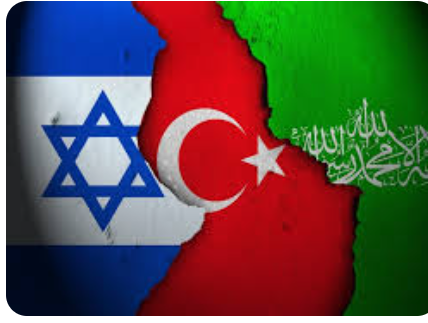
Turkey–Israel ties have entered one of their tensest periods in recent memory. What began as a diplomatic crisis over Gaza has widened into a broader geopolitical confrontation, shaped by diverging visions in Syria, escalating rivalries with Iran, and—most dramatically—Israel’s unprecedented strike on Qatar, Ankara’s closest Gulf ally.
Gaza: From Morality to Security
Since the war in Gaza began, Turkey has condemned Israel’s campaign as a humanitarian disaster. Initially, Ankara’s stance was framed in moral and domestic political terms. President Erdoğan resisted concrete measures but eventually bowed to public anger, closing Turkish airspace and suspending trade.
Yet Gaza, for Ankara, is not primarily a strategic theater. Trade suspensions have been partial, with flows continuing indirectly through third countries. For Turkey, the deeper issue is not Gaza itself, but the regional chain reaction it has triggered.
Syria: Competing Visions
Syria has become the arena where Turkey feels its influence has grown most. With a new post-Assad order taking shape, Ankara envisions a unified, centralized Syrian state capable of curbing threats and stabilizing the region. Turkey hopes Gulf and Western funds will finance reconstruction, stimulating its own construction sector.
Israel, by contrast, favors a weak, decentralized Syria, fragmented and militarily neutered—closer to Lebanon’s model. This stark divergence places Ankara and Tel Aviv at cross-purposes.
Despite this rivalry, both sides have so far avoided direct confrontation in Syria. Azerbaijan has quietly attempted back-channel mediation, and military deconfliction mechanisms remain in place.
Iran: Proxy Rivalry vs. Red Lines
Turkey’s rivalry with Iran is both competitive and cautious. Ankara sees Israel’s strikes on Iran-backed groups in Syria and Lebanon as indirectly useful, since they weaken Tehran’s influence.
But Turkey draws a red line at direct strikes on Iranian territory. Israel’s recent twelve-day assault on Iran rattled Ankara, raising fears of uncontrollable escalation. While proxy battles are tolerated, an outright attack on Iran is viewed as destabilizing and dangerous.
Qatar: The Most Dangerous Escalation
The turning point came with Israel’s September 2025 strike on a Hamas delegation in Qatar. For Ankara, Qatar is more than a partner—it is a strategic pillar of Turkish foreign policy, bound by defense, financial, and political ties.
By striking Qatar, a US-designated major non-NATO ally, Israel crossed a line that even its campaign against Iran had not. It challenged not only regional norms but also the credibility of the American security umbrella.
For Turkey, this was the clearest signal yet that Israel is willing to defy prior deterrents, diplomatic understandings, and even Washington’s implicit red lines.
NATO, Constraints, and Military Gaps
Despite fiery rhetoric, structural limits make a full-scale Turkey–Israel clash unlikely. Ankara remains anchored in NATO and benefits from collective security in theory. Yet doubts about NATO’s reliability run deep, rooted in past crises where solidarity was limited to words.
Turkey’s military posture adds further caution. Its armed forces have proven capable against irregular groups in Syria and Libya, but vulnerabilities remain—particularly in the air force, weakened by the F-35 expulsion, stalled F-16 upgrades, and pilot shortages after 2016 purges. Unlike Iran, Turkey lacks a missile program to offset gaps.
Thus, Ankara calibrates its response: tough rhetoric for domestic audiences, partial trade suspensions as symbolic gestures, but no irreversible moves toward direct confrontation.
Thresholds Eroded, Order at Risk
The danger lies less in Turkey’s willingness to escalate than in the erosion of regional red lines. Israel’s strike on Iran normalized interstate attacks. Its strike on Qatar broke an even higher taboo, demonstrating that even a US-allied state hosting major Western bases is not immune.
This erosion of thresholds undermines confidence in US guarantees, pushing regional actors to hedge. The recent Saudi–Pakistan security pact is one example of states diversifying their security options amid uncertainty over Washington’s role.
For Ankara, the message is stark: allies once thought untouchable may no longer be safe, and strategic assumptions must be recalibrated.
Conclusion: Israel’s Escalation, Washington’s Dilemma
Turkey–Israel relations today reflect more than bilateral disputes. They expose how Israel’s expanding regional footprint—and Washington’s inability or unwillingness to restrain it—are reshaping the Middle East order.
Unless the US enforces limits on its ally, Israel’s unilateral actions will continue to erode red lines, raising the risk of spirals no actor desires. For Turkey, even without seeking confrontation, the very discussion of a possible clash with Israel underscores how much the regional landscape has shifted in just a matter of months.
This is a summary of a much larger article by Salim Cevik, which you can access here