Global Energy Crisis Shifts Focus to Türkiye
 boru hatları
The escalating conflict involving the U.S., Israel, and Iran has disrupted the Strait of Hormuz, triggering a global energy shock. As supply routes become increasingly vulnerable, Türkiye is emerging as a strategic energy hub, with major pipeline projects positioning it at the center of a new global energy architecture.
The closure of the Strait of Hormuz amid rising tensions between the United States, Israel, and Iran has sent shockwaves through global energy markets. The disruption of one of the world’s most critical النفط transit routes has driven oil prices sharply higher, intensifying inflationary pressures and raising recession risks worldwide.
Energy Security Takes Priority Over Cost
Energy expert Altuğ Karataş said the ongoing conflict is not only producing military consequences but is also reshaping the global economic and energy landscape. The surge in oil prices is feeding into a broad-based cost shock, affecting sectors ranging from fertilizers and transportation to petrochemicals and food.
According to Karataş, the crisis is accelerating a structural shift in global energy trade:
“No country wants to remain dependent on high-risk regions for energy supply. Strategic chokepoints like Hormuz are no longer just commercial routes but security liabilities. The principle of ‘shortest route’ is being replaced by ‘safest route.’ Energy security has become the top priority.”
Türkiye Gains Strategic Leverage
Amid this transformation, Türkiye is increasingly seen as a key geopolitical and economic player. Karataş highlighted Ankara’s ability to maintain dialogue simultaneously with the U.S., Russia, Gulf states, and Europe—an advantage few countries possess.
This multi-directional diplomacy, he said, is boosting Türkiye’s appeal as an energy partner, encouraging countries such as Egypt, Qatar, Iraq, and Turkmenistan to deepen cooperation with Ankara.
Türkiye, Syria Reopen Transit Route to Gulf as Hormuz Crisis Reshapes Trade
Four Mega Projects Could Turn Türkiye Into an Energy Hub
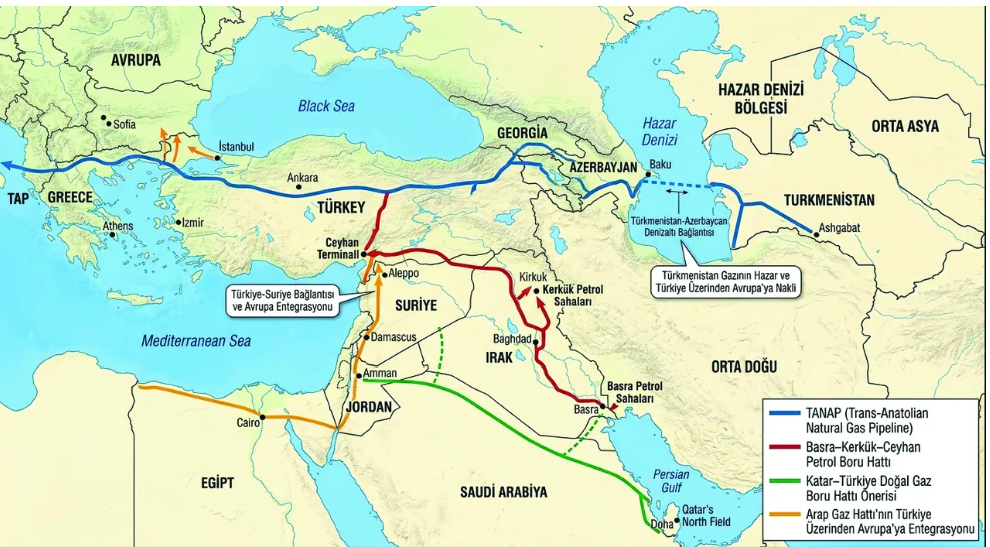
Türkiye’s rising role is underpinned by four major international energy projects:
- Trans-Caspian Gas Corridor: A planned route to transport 10 billion cubic meters of Turkmen gas annually via the Caspian Sea and connect it to Europe through TANAP.
- Basra–Kirkuk–Ceyhan Oil Corridor: A pipeline with a capacity of 1.5 million barrels per day, offering a secure alternative to Gulf routes.
- Qatar Gas Route: A proposed project to deliver over 10 billion cubic meters of Qatari natural gas to Europe through Türkiye.
- Arab Gas Pipeline Integration: A system designed to channel around 10 billion cubic meters of gas annually into European markets via Türkiye.
These projects could significantly enhance Türkiye’s role not just as a transit country but as a central node in global energy trade.
“Türkiye Could Become a Rule-Setter”
Karataş emphasized that energy is no longer merely a commercial issue but a matter of strategic power and national security. He argued that Türkiye’s geographic position at the crossroads of Europe, Asia, and Africa gives it a unique advantage:
“Türkiye is evolving from a transit country into a full-fledged energy hub. These projects will generate billions of dollars in economic value while creating a more secure regional energy system. Türkiye is well positioned to become one of the countries that shapes the rules of the new energy order.”
Source: Turkiye Gazette