Türkiye Emerges as a Key Energy and Trade Corridor Amid Global Route Shifts
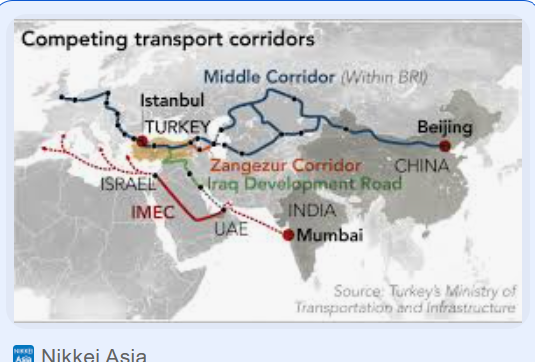 transport corridors
As the disruption in the Strait of Hormuz forces a rethink of global energy and trade routes, Türkiye is rapidly emerging as a critical transit hub. From oil pipelines to the Middle Corridor connecting Asia and Europe, Ankara’s strategic position is gaining renewed importance in a fragmented global system.
Hormuz Disruption Accelerates Search for Alternatives
The ongoing conflict involving Iran has effectively constrained traffic through the Strait of Hormuz, a chokepoint for:
- ~20% of global oil and LNG flows
- Key energy supplies to Asia and Europe
This has triggered:
- Sharp increases in oil and gas prices
- Supply chain disruptions
- Urgent efforts to diversify transport routes
In this context, alternative corridors—both energy and logistics—are gaining prominence.
Türkiye Positioned as a Strategic Energy Hub
Türkiye is increasingly being viewed as a viable alternative route for energy flows.
Energy Minister Alparslan Bayraktar highlighted that:
- The Kirkuk–Ceyhan pipeline has a capacity of 1.5 million barrels per day
- It can play a key role in redirecting crude flows from northern Iraq to global markets
Additional proposals under discussion include:
Qatar–Türkiye–Europe Gas Pipeline
- Transport Qatari natural gas via pipeline to Türkiye
- Extend supply onward to European markets
This concept becomes particularly relevant if:
👉 LNG infrastructure is disrupted and Hormuz remains closed
LNG Supply More Fragile Than Oil
While oil has limited rerouting options, LNG remains highly dependent on Hormuz.
- Short-term alternatives are insufficient
- Redirection is operationally complex
This reinforces Türkiye’s role as:
👉 A complementary corridor for non-Hormuz energy flows into Europe
Middle Corridor Gains Strategic Momentum
Beyond energy, logistics routes are also being reshaped.
The Middle Corridor (Trans-Caspian Route) connects:
- China → Central Asia → South Caucasus → Türkiye → Europe
Key advantages:
- Bypasses Russia and Iran
- Faster than maritime routes
- Less exposed to geopolitical chokepoints
Recent developments have amplified its relevance:
- Red Sea disruptions
- Security risks in Bab el-Mandeb
- Delays via the Cape of Good Hope
👉 Result: The Middle Corridor is emerging as the most efficient East-West route
Türkiye as the Gateway to Europe
Türkiye is the final and most critical link in this corridor.
- Transit time: 12–18 days
- Cargo volumes have quadrupled since 2022
- World Bank projects 11 million tons by 2030
Türkiye’s role:
👉 Primary gateway for Asian goods entering Europe
Dual Advantage: Energy + Logistics
Türkiye’s strategic strength lies in combining two roles:
1. Energy Transit Hub
- Russian gas via TurkStream
- Iraqi oil via Ceyhan
- Potential Gulf gas pipelines
2. Logistics Backbone
- Expanding rail infrastructure
- Port capacity growth
- Istanbul Northern Rail Crossing Project (INRAIL) backed by $2 billion World Bank financing
South Caucasus Becomes Critical
Countries such as:
- Azerbaijan
- Georgia
- Armenia
are gaining importance as part of the corridor.
- Azerbaijan already supplies ~4% of Europe’s gas
- Target: 20 bcm by 2027
However, a key constraint remains:
👉 Regional stability
Global Competition Intensifies
The Middle Corridor is also a geopolitical arena:
- US-backed TRIPP project
- China’s Belt and Road investments
- EU diversification strategies
Türkiye’s position:
👉 A balancing power between competing global blocs
Expert View: A Medium-Term Strategic Alternative
According to Claudia Kemfert (German Institute for Economic Research):
- Prolonged Hormuz disruption will keep energy prices elevated
- Alternative pipelines lack sufficient capacity
- Türkiye cannot fully offset shocks in the short term
But:
👉 It can emerge as a critical medium-term energy corridor
Conclusion
The Hormuz crisis is not just an energy shock—it is reshaping global trade architecture.
In this evolving landscape:
- Energy security
- Supply diversification
- Trade efficiency
are becoming central priorities.
👉 Türkiye stands out as a strategic bridge between East and West, with rising influence in both energy transit and global logistics.
AA, DW, WS37
Related articles
Türkiye aims to become hub for technology companies
Energy shortages to deal blow to exporters, supply chain center ambitions

Global Banks See Carry Trade Gains Extending Into 2026, With Türkiye Among Top Picks