Mehmet Ögütcü: If Hormuz Is Asia’s Artery, Malacca Is Its Chokepoint
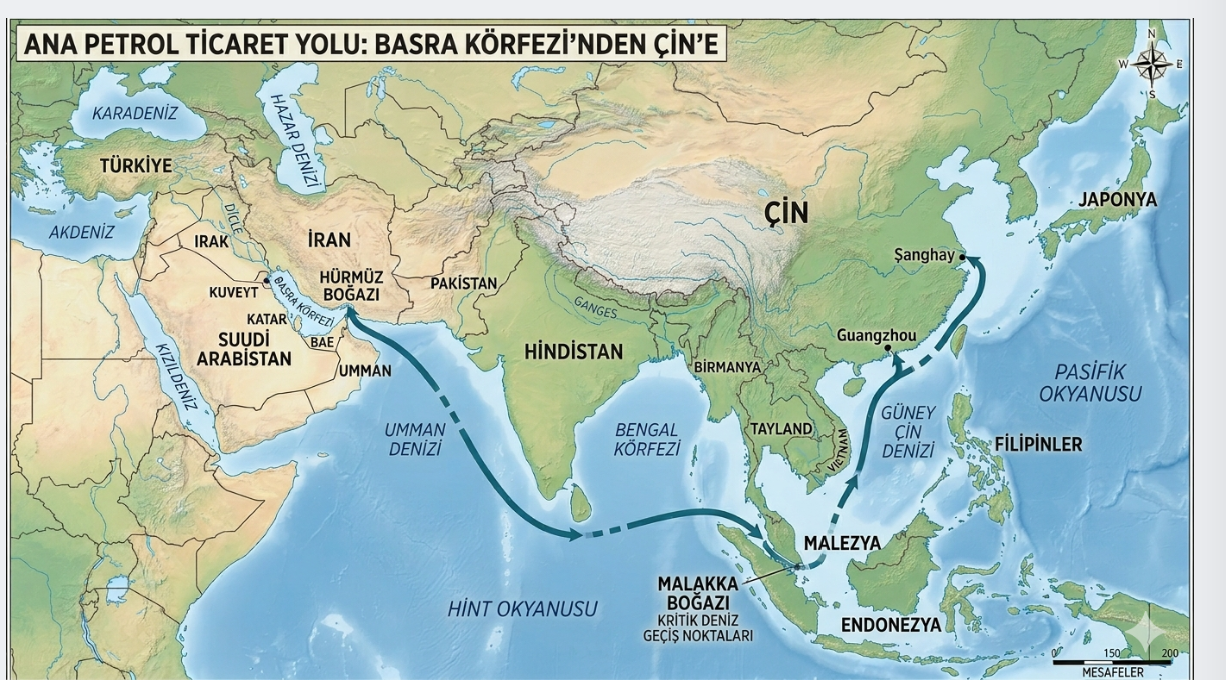 malaka bogazi
While the Strait of Hormuz is widely seen as the heart of the global energy system, its true strategic importance lies in its role as Asia’s primary energy lifeline. Yet the real vulnerability emerges further downstream at the Strait of Malacca, where energy flows converge. In today’s geopolitical landscape, competition is shifting from resources to the routes that carry them.
Hormuz: Global Gateway, Asian Lifeline
The Strait of Hormuz is often described as the world’s most critical energy corridor. While accurate, this definition is incomplete.
Each day, roughly:
- 20–21 million barrels of oil
- About 20% of global oil consumption
- Around 20% of global LNG trade
passes through this narrow waterway.
However, the key issue is not just volume—but direction.
Under normal conditions:
- 83–89% of oil and LNG flows through Hormuz are destined for Asia
This makes Hormuz not just a global chokepoint, but effectively Asia’s economic lifeline.
Asia: Structural Dependence
Asia’s vulnerability is not merely quantitative—it is structural.
Major consumers include:
- China
- India
- Japan
- South Korea
Together, these economies account for:
- 70–75% of oil transported through Hormuz
- Approximately 27% of Asia’s LNG imports
For Asia, Hormuz is not optional—it is essential.
Any disruption would mean:
- Industrial slowdowns
- Supply chain disruptions
- Weaker economic growth
Europe: Limited Exposure, High Sensitivity
Europe’s direct reliance on Hormuz is relatively modest:
- Around 4% of oil flows
- Roughly 7% of LNG flows
However, Europe’s vulnerability lies not in volume, but in impact.
- Rising energy prices
- Refining disruptions
- Increased insurance and shipping costs
can quickly translate into economic pressure.
As a result, Europe remains:
- Militarily cautious
- Economically sensitive
United States: Less Dependent, Still Exposed
The United States has significantly reduced its dependence on Gulf energy supplies.
- Oil from Hormuz accounts for roughly 2% of US consumption
This supports the argument that Hormuz is not directly critical for the US.
But this view is incomplete.
Oil is a global commodity:
- Disruptions in Hormuz → global price spikes
- Price spikes → indirect impact on the US economy
Even without physical dependence, the US cannot escape the price effect.
Türkiye: Financial, Not Physical Vulnerability
Türkiye’s dependence on imported energy is high, but its direct reliance on Gulf supplies is limited.
- Middle Eastern oil accounts for roughly 10% of imports
However, Türkiye’s main vulnerability is not supply—it is pricing.
Higher oil prices lead to:
- Rising inflation
- Wider current account deficits
- Increased industrial costs
For Türkiye, Hormuz is not a supply route, but a macroeconomic pressure point.
Malacca: The True Bottleneck
This raises a critical question:
If Hormuz is Asia’s artery, where is that artery constricted?
The answer is increasingly clear: the Strait of Malacca.
Malacca:
- Connects the Indian Ocean to the Pacific
- Handles roughly 23 million barrels of oil per day
This volume rivals Hormuz.
China’s Strategic Vulnerability
For China, the picture is even more sensitive.
- Hormuz → entry point for energy
- Malacca → gateway to the domestic economy
A significant portion of China’s:
- Maritime trade
- Energy imports
passes through Malacca.
This makes it a strategic chokepoint for Beijing.
China’s Response: Diversification Strategy
To reduce this vulnerability, China is pursuing multiple alternatives:
- Belt and Road Initiative (BRI)
- Gwadar Port in Pakistan
- Energy corridors via Myanmar
- Arctic shipping routes with Russia
The goal is clear:
Avoid dependence on a single chokepoint
A New Geopolitical Era: The War of Routes
Global competition is no longer just about resources.
It is increasingly about routes and corridors.
Key chokepoints include:
- Hormuz
- Malacca
- Bab el-Mandeb
- Suez Canal
- Panama Canal
- Gibraltar
- Turkish Straits (Istanbul and Çanakkale)
These are no longer just geographic passages—they are centers of geopolitical power.
Recent disruptions in the Red Sea and Suez have exposed how fragile this system has become.
A Strategic Opportunity for Türkiye
This transformation presents a strategic opportunity for Türkiye.
Türkiye is not only a transit country—it has the potential to become a route architect.
Its geographic position connects:
- Central Asia
- The Black Sea
- The Middle East
- The Gulf
- Europe
Key projects include:
- Zangezur Corridor
- Middle Corridor
- Development Road
These are not just infrastructure initiatives—they are geopolitical leverage tools.
Power Now Lies in Pathways
The global system is undergoing a fundamental shift.
Power is no longer defined solely by where resources are located, but by how they move.
Hormuz may be global—but for Asia, it is indispensable.
And if great power competition intensifies:
- The decisive battleground may not be Hormuz
- But Malacca
Conclusion: The Logic of a New World
The emerging reality is clear:
Future conflicts will not be fought only over energy resources—but over the routes that carry them.
In this context, remarks by US President Donald Trump stand out:
“Go get your own oil. Keep Hormuz open yourselves.”
The statement may be controversial.
But it reflects a deeper understanding of a world where control over routes—not just resources—defines power.
Adapted from the author’s article at Yetkin Report
PA Turkey intends to inform Turkey watchers with diverse views and opinions. Articles in our website may not necessarily represent the view of our editorial board or count as endorsement.
Follow our English YouTube channel (REAL TURKEY):
https://www.youtube.com/channel/UCKpFJB4GFiNkhmpVZQ_d9Rg
Twitter: @AtillaEng
Facebook: Real Turkey Channel: https://www.facebook.com/realturkeychannel/***