Bahçeli Says Regional Turmoil Has Created a New Opening for Türkiye’s Global Ambitions
 bahceli
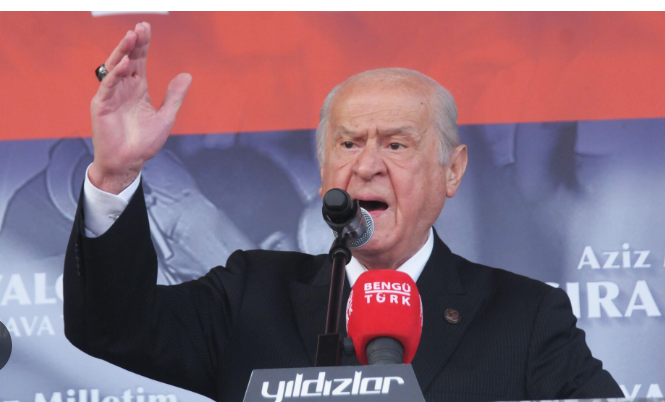
MHP leader Devlet Bahçeli used his party’s parliamentary group meeting to argue that the escalating war environment around Türkiye has created what he called a new historic opportunity for the country to rise as a global power. Framing the regional crisis as both a warning and a strategic opening, Bahçeli linked Türkiye’s external security environment to his long-standing call for a “terror-free Türkiye,” praised Ankara’s diplomatic posture in the Iran conflict, and urged stronger national unity amid rising geopolitical risks. He also sharply criticized Israel, warned of a wider regional war, and said Türkiye must not yield to foreign pressure on issues of national security and sovereignty.
Bahçeli Ties Regional Crisis to Türkiye’s Long-Term Strategic Vision
Nationalist Movement Party (MHP) leader Devlet Bahçeli said the upheaval spreading across the Middle East has created a new opportunity for Türkiye to emerge as a global power, linking regional instability to Ankara’s broader national strategy.
Speaking at his party’s weekly group meeting in the Turkish parliament, Bahçeli said the international system was failing to protect civilians, preserve peace, or uphold humanitarian principles, while countries in Türkiye’s neighborhood were being drawn deeper into conflict.
Against that backdrop, he argued that Türkiye should respond not with hesitation but with a clearer strategic vision.
According to Bahçeli, the idea of the “Century of Türkiye” and the goal of a “terror-free Türkiye” should be treated as complementary strategic roadmaps. He said the current geopolitical rupture had made these goals more urgent and more attainable.
Bahçeli described the present period as a historic turning point, saying Türkiye had both a national duty and a civilizational responsibility extending beyond its borders to the wider Turkic and Islamic worlds.
Calls for Unity at Home as Wars Intensify Abroad
A central theme of Bahçeli’s speech was that external threats make domestic unity more important than ever.
He said wars across neighboring regions had demonstrated the cost of fragmentation and the strategic value of internal cohesion. In that context, he again defended the political objective of a “terror-free Türkiye,” portraying it as essential not only for domestic security but also for strengthening the country’s geopolitical position.
Bahçeli argued that the continuing conflict in Iran had shown that no outside force could easily prevail against a society that remains united around state institutions. He said the lesson for Türkiye was clear: internal solidarity is a precondition for resilience in a dangerous region.
He also repeated one of the governing alliance’s core messages in recent months, saying that ethnic and sectarian polarization would only weaken the country at a time when the surrounding geography was becoming more unstable.
In one of the strongest passages of his address, Bahçeli said Turks and Kurds shared a common future within the Republic of Türkiye and that attempts to divide the country along ethnic lines must be rejected. He framed national identity in civic and state-centered terms, saying, “We are all the Turkish nation, we are all the Republic of Türkiye.”
“Terror-Free Türkiye” Presented as a Strategic Security Doctrine
Bahçeli devoted a large part of his speech to defending the government-backed vision of a “terror-free Türkiye,” arguing that the initiative should not be reduced to a narrow security slogan.
Instead, he presented it as a wider doctrine linking national unity, economic stability, diplomatic influence, and long-term strategic autonomy.
He said the relevant commission working on the issue would continue preparing reports and that democratic and legal arrangements would be implemented gradually. At the same time, he cautioned against rhetoric that could create misunderstandings, deepen anxieties, or inflame public debate.
That language suggested a preference for a tightly managed political process, one in which security priorities remain central while legislative steps are taken incrementally.
Bahçeli also criticized those who had dismissed the “terror-free Türkiye” concept, saying recent regional developments had strengthened the logic behind it. He argued that in an environment of expanding wars, sanctions, and covert operations, Türkiye could not afford to remain vulnerable to internal destabilization.
Sharp Warning Over Expanding Iran War
Bahçeli said the conflict involving the United States, Israel and Iran had entered a dangerous phase with potentially uncontrollable consequences.
Referring to the war as having reached its 25th day, he said neighboring geographies had been thrown into chaos and that statements by U.S. President Donald Trump, Iranian officials, and Israeli leaders were pushing hopes for peace further away.
He pointed to attacks on energy infrastructure, nuclear facilities, and retaliatory strikes across the region as evidence that the conflict was no longer confined to a limited battlefield. In his view, threats involving the Strait of Hormuz, Bab el-Mandeb, the Gulf and the Suez corridor showed how quickly the crisis could spread into a broader energy, trade, and security shock.
Bahçeli said the political, military, and economic pressures now building in the region resembled — and perhaps exceeded — the dangerous escalation patterns seen before the First and Second World Wars.
He warned that targeted assassinations of top state and political figures, rising speculation about wider war, and increasingly routine references to nuclear scenarios were all signs that the conflict had moved into a far more unpredictable phase.
Praise for Turkish Diplomacy
Despite his grim assessment of the regional outlook, Bahçeli praised Türkiye’s diplomatic response and said Ankara was acting with seriousness and balance.
He commended President Recep Tayyip Erdoğan for continuing diplomatic contacts and said Foreign Minister Hakan Fidan was representing Türkiye’s messages and sensitivities in a measured but active way.
According to Bahçeli, Turkish foreign policy was pursuing peace and dialogue even as the region moved in the opposite direction. He described Türkiye’s diplomacy as careful, prepared, courageous and constructive.
That praise aligned with the governing bloc’s effort to present Türkiye as a stabilizing power capable of speaking with multiple actors during a time of intense regional fragmentation.
At the same time, Bahçeli said the divide between the warring sides had hardened to the point that diplomacy faced major obstacles. He cited recent U.S. warnings over Hormuz and Iranian threats to target regional energy, information technology and desalination infrastructure if energy security were violated.
For Bahçeli, those exchanges showed how close the region had come to a broader Gulf war — one that would not remain geographically contained.
Criticism of International Institutions and Western Powers
Bahçeli delivered a sweeping critique of the international order, arguing that humanitarian law had effectively collapsed.
He said the United Nations, established to preserve peace and uphold human rights, had become ineffective and had lost both legal authority and political credibility.
That criticism was paired with direct attacks on Israel and the United States. Bahçeli described the strikes on Iran as disproportionate, unjust and unjustified, and said Israeli military actions in Syria and Lebanon had further escalated regional tensions.
He also accused Israel of undermining regional peace and used some of the harshest language of his speech to condemn its conduct in Gaza, Jerusalem and the wider Middle East.
In one of the most politically charged sections of the address, Bahçeli said the real “regime change” needed in the region should occur in Israel, not elsewhere. He also warned against what he described as Israel’s undue influence over U.S. political decision-making.
These remarks reflected the increasingly confrontational tone adopted by segments of Türkiye’s political establishment as the regional war has intensified.
Gaza, Jerusalem and Al-Aqsa Return to the Center of Political Messaging
Bahçeli also devoted substantial attention to Jerusalem and the Al-Aqsa Mosque, placing them within a broader narrative about Islamic solidarity and the defense of sacred spaces.
He said restrictions at Al-Aqsa during Ramadan had deeply angered the Muslim world and argued that no one had the right to alter the spiritual or historical status of the site.
For Bahçeli, the issue was not merely religious but geopolitical, symbolizing what he sees as the moral collapse of the current regional and international order.
By broadening the speech from national security to civilizational themes, he sought to place Türkiye’s role in a wider historical frame — one in which Ankara has obligations not just to its citizens, but also to Muslim societies and Turkic communities beyond its borders.
Domestic Development and Regional Power Are Framed as Linked Goals
Another notable feature of Bahçeli’s speech was the way he tied foreign policy, internal security and economic stability into one strategic package.
He urged support for a stronger, safer and more prosperous Türkiye, arguing that the country must aim not only for military security but also for economic welfare, diplomatic influence and what he called a “golden age” in foreign relations.
This framing is significant because it suggests the ruling alliance is continuing to define national power in multidimensional terms: not simply as military capability, but as a combination of domestic order, economic resilience, diplomatic activism and ideological coherence.
Bahçeli insisted that Türkiye should draw its own national strategy from its values, beliefs and historical mission rather than from foreign pressure or external geopolitical engineering.
He said the country should not leave its national unity, security, economic future or strategic interests to what he called colonial ambitions, Zionist plans or the initiative of dominant global powers.
A Hardening Tone, but Also a Call for Diplomacy
Although the speech was marked by hardline rhetoric, Bahçeli also called for the wars in the region to end and for diplomacy to take precedence over military escalation.
He said civilians, children and defenseless populations were paying the price of the conflicts and that the international community could no longer watch from the sidelines.
In that sense, his message blended nationalist defiance with a call for de-escalation — though always from the standpoint of defending Türkiye’s sovereignty and regional standing.
He argued that war must stop, weapons must fall silent, and diplomacy and dialogue must come forward. Yet he also said Türkiye would not bow to threats and would not compromise on its national interests regardless of the consequences.
That duality — calling for peace while warning of firm resistance — has increasingly become a defining feature of Turkish political rhetoric during the current regional crisis.