How Türkiye Can Help the South Caucasus Diversify Its Economies
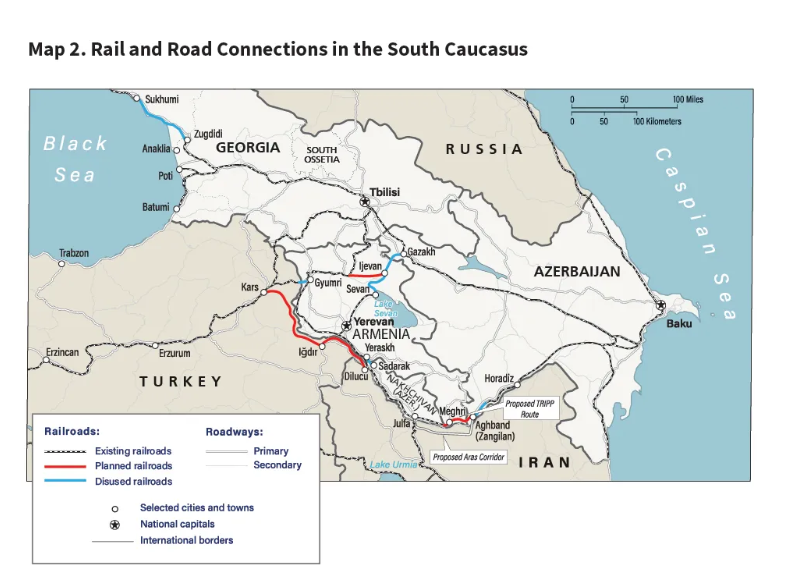 kafkasya connectivity
Russia’s declining influence in the South Caucasus following the Ukraine war has created a rare geopolitical opening. Countries in the region now have an opportunity to diversify their economies and integrate into European value chains. Türkiye, with its industrial capacity and strategic geography, is well positioned to act as a bridge between the EU, the South Caucasus, and Central Asia. However, realizing this potential will require improved connectivity, regulatory reforms, and coordinated regional strategies.
A Strategic Opening for Economic Transformation
The weakening of Russia’s regional dominance has reshaped the South Caucasus’ economic and political landscape. For countries such as Armenia, Azerbaijan, and Georgia, the moment presents an opportunity to move beyond traditional dependence on resource-based exports and Russian-linked trade networks.
Diversification is not only an economic objective but also a strategic necessity. Stronger, more competitive economies are closely tied to political stability, resilience, and long-term security.
Closer integration with EU value chains—through trade, investment, and technology transfer—offers a pathway to achieve this transformation.
Türkiye’s Unique Role as a Connector
Türkiye stands out as a key enabler of this transition. Its deep integration into European markets through the EU–Türkiye Customs Union has transformed the country into a major manufacturing and export hub.
Since the 1990s, Türkiye has significantly expanded:
- The diversity of its export products
- The number of markets it serves
- Its role in global supply chains
Today, Türkiye acts as a bridge between advanced European industries and emerging markets to its east.
In this context, Ankara can help link the South Caucasus and Central Asia to EU value chains by combining:
- European technology and investment
- Turkish industrial and commercial capacity
- Regional production potential
Structural Weakness: Limited Regional Integration
Despite geographic proximity, economic integration in the South Caucasus and Central Asia remains weak.
Key challenges include:
- Low levels of intraregional trade
- Limited industrial linkages
- Heavy reliance on energy exports
Unlike Central European and Baltic countries—which integrated into EU markets and increased their productive capacity—South Caucasus economies remain largely tied to Russian trade and investment networks.
Even today, excluding oil and gas exports, Russia remains a dominant trading partner for many countries in the region.
Legacy Constraints and Political Barriers
Several structural and political factors have hindered regional integration:
- The Soviet-era “hub-and-spoke” system, which prioritized links with Moscow rather than between republics
- Closed borders, particularly between Türkiye and Armenia
- Long-standing conflicts, including Armenia-Azerbaijan tensions and Georgia’s disputes with Russia
These constraints have limited the free movement of goods, capital, and people, slowing economic development.
Connectivity as a Game Changer
Infrastructure development has emerged as a critical lever for regional transformation.
Over the past two decades, projects such as:
- The Baku–Tbilisi–Ceyhan oil pipeline
- The South Caucasus gas pipeline
- The Baku–Tbilisi–Kars railway
have strengthened regional links.
More recently, new initiatives have gained momentum. A proposed connectivity framework—known as the Trump Route for International Peace and Prosperity (TRIPP)—aims to connect Azerbaijan to its Nakhchivan exclave via Armenia, extending onward to Türkiye.
If implemented, TRIPP could:
- Revive Soviet-era rail connections
- Provide alternative trade routes to existing corridors
- Increase resilience against geopolitical disruptions
This project would complement Türkiye’s broader Middle Corridor strategy, linking Europe to Central Asia.
The Middle Corridor: Beyond China
Originally designed as a route connecting Europe to China, the Middle Corridor has evolved into a broader strategy aimed at integrating Central Asia more directly into regional economic systems.
Climate change and geopolitical tensions have reinforced this shift. The corridor is now seen as a tool to:
- Support economic diversification in Central Asia
- Reduce dependence on single-resource economies
- Strengthen regional resilience
Türkiye’s role as a logistics hub is central to this vision.
Climate Pressures and Migration Risks
Long-term climate trends add another layer of urgency.
By 2070, large parts of the Middle East, Africa, and South Asia may face extreme heat conditions, increasing the likelihood of mass migration toward relatively cooler regions such as Türkiye and Europe.
The South Caucasus and Central Asia, with their lower population densities and available land, could emerge as alternative destinations.
However, this would require:
- Stronger economies
- Job creation
- Institutional capacity
Economic diversification is therefore critical not only for growth but also for managing future migration pressures.
Türkiye’s Domestic Stakes
Türkiye’s engagement in the South Caucasus also has domestic implications.
Eastern Anatolia—particularly provinces bordering Armenia—remains one of the least developed regions in the country. Opening the Türkiye–Armenia border could:
- Boost trade and investment
- Improve regional connectivity
- Stimulate local economic development
Integrating these provinces into regional trade networks would help reduce internal economic disparities.
Barriers to Implementation
Despite the potential, significant obstacles remain:
Infrastructure gaps (hardware):
- Limited transport capacity
- Bottlenecks at ports and rail interfaces
Regulatory and procedural issues (software):
- Weak customs coordination
- Lack of integrated IT systems
- Tariff and administrative barriers
Institutional weaknesses:
- Underdeveloped private sectors
- Slow reform processes
- Limited ability to attract high-value foreign investment
As a result, more than half of foreign direct investment in the region continues to flow into resource-based industries.
A Framework for Regional Cooperation
To unlock the region’s potential, a coordinated strategy is needed.
Key elements include:
Linking Value Chains
Central Asian countries such as Uzbekistan could develop industrial capacity by partnering with the EU and Türkiye.
Sectoral Transformation
Smaller South Caucasus economies could focus on:
- Tourism
- Ecotourism
- IT and digital services
Tourism as a Starting Point
Cross-border tourism between Türkiye and Armenia offers immediate potential.
Practical steps could include:
- Opening the border to international tourists
- Building partnerships between tour operators
- Developing joint tourism routes
Such initiatives could deliver a “peace dividend” while creating jobs and fostering cooperation.
The Way Forward
The convergence of geopolitical shifts, infrastructure initiatives, and economic needs presents a unique opportunity.
Türkiye, with its industrial base and connectivity role, can:
- Anchor regional integration
- Facilitate access to EU markets
- Drive economic diversification
Turkish companies, in particular, could lead investments in:
- Manufacturing
- Logistics
- Transportation
Related articles
Emre Demir: Kanal Istanbul, Turkey’s Middle Corridor, and the Belt and Road Initiative

Iran war may accelerate Armenia–Azerbaijan peace push and reshape regional trade routes

OPINION: Iran’s Weakening Is Turkey’s Opportunity — and Its Trap