Gönül Tol: Türkiye Caught in the Vortex of a Widening Iran War
 turkiye ates cemberi2
The escalating war between the United States, Israel, and Iran is creating mounting economic and security risks for Türkiye. Recent incidents, including NATO’s interception of Iranian missiles headed toward Turkish territory and rising tensions in the Eastern Mediterranean, underscore Ankara’s growing exposure to the conflict. Analysts warn that a prolonged war could drive up energy prices, threaten key infrastructure such as the Baku–Tbilisi–Ceyhan pipeline, and complicate Türkiye’s delicate domestic political process involving Kurdish groups.
Türkiye Increasingly Drawn Into Regional Conflict
After months of attempting to prevent a US–Israeli war with Iran, Türkiye now finds itself increasingly entangled in the conflict.
Recent developments suggest that Ankara’s long-standing concerns about the war spilling over into neighboring countries are beginning to materialize.
On March 4, NATO air and missile defense systems intercepted an Iranian ballistic missile reportedly headed toward Türkiye, believed to be targeting the Incirlik Air Base in southern Türkiye.
According to the Turkish Ministry of Defense, the missile was launched from Iran and traveled through Iraqi and Syrian airspace before being detected en route to Turkish territory. NATO defense assets stationed in the Eastern Mediterranean destroyed the missile before it crossed into Türkiye’s airspace.
Debris later discovered in the southern province of Hatay was identified as fragments from the interceptor missile used to neutralize the threat.
A second Iranian ballistic missile was intercepted on March 9 after entering Turkish airspace.
Turkish Foreign Minister Hakan Fidan conveyed Ankara’s protest to his Iranian counterpart after the first incident, warning that Türkiye would respond if similar incidents occurred again.
Iran’s military denied targeting Türkiye, insisting that the Islamic Republic respects Türkiye’s sovereignty.
Iran’s Leadership Crisis Raises Escalation Risks
However, internal dynamics in Iran make such assurances difficult to rely on.
The US–Israeli strikes that began on February 28 reportedly killed several senior Iranian military and political figures, including Islamic Revolutionary Guard Corps (IRGC) commander Mohammad Pakpour and Supreme Leader Ayatollah Ali Khamenei, who previously held ultimate authority over national security decisions.
With Iran’s leadership structure weakened, the country has activated its “mosaic defense” strategy, which decentralizes wartime command by granting greater authority to local IRGC commanders.
While this structure allows Iran to continue military operations even if senior leadership is eliminated, it also increases the risk of uncoordinated missile and drone attacks, potentially triggering unintended escalation.
Iran’s broader strategic objective appears to be expanding the conflict across the Middle East while increasing the economic costs for US President Donald Trump, particularly by disrupting regional trade routes and energy flows.
Why the Next Escalation in the Iran Conflict Could Be Between the US and Türkiye
BTC Pipeline Seen as a Strategic Vulnerability
For Türkiye, the war poses serious risks due to its location at the crossroads of critical global energy routes.
One particularly vulnerable asset is the Baku–Tbilisi–Ceyhan (BTC) oil pipeline, which carries oil from Azerbaijan through Georgia to Türkiye’s Mediterranean port of Ceyhan.
The pipeline supplies energy to European markets and reportedly accounts for roughly one-third of Israel’s oil imports.
Iran has signaled that the BTC pipeline could become a potential target.
Azerbaijan has already reported thwarting several sabotage attempts linked to Iran’s Islamic Revolutionary Guard Corps, including a plot targeting the pipeline.
An attack on BTC would not only represent a major security incident but could also disrupt global energy markets, placing additional pressure on Türkiye’s already fragile economy.
Rising Oil Prices Could Deepen Economic Strains
The longer the war continues—particularly if shipping through the Strait of Hormuz remains disrupted—the greater the risk that oil prices will rise further.
Crude prices are already trading above $100 per barrel, and further increases would have immediate consequences for Türkiye’s energy-dependent economy.
Economists estimate that every $10 increase in oil prices could widen Türkiye’s current account deficit by approximately $7 billion, while simultaneously intensifying inflationary pressures.
Turkish officials cited by the author say Iran and its allies still possess tens of thousands of drones, missiles, and rockets, potentially allowing the conflict to continue for four to five months.
Such a scenario would be particularly problematic for President Recep Tayyip Erdoğan, who had been hoping to stabilize the economy ahead of possible early elections in 2027.
Concerns Over Kurdish Militants
Another major concern for Ankara is the possibility that the United States or Israel could arm Iranian Kurdish groups linked to the Kurdistan Workers’ Party (PKK).
Türkiye considers such groups a direct security threat, especially given its large Kurdish population.
The timing is also sensitive domestically.
Türkiye has been negotiating with imprisoned PKK leader Abdullah Öcalan in an effort to end the group’s decades-long insurgency.
The talks are part of a broader political strategy aimed at securing the support of the pro-Kurdish parliamentary bloc, which could be crucial if constitutional changes are required for Erdoğan to run in future elections.
Last year, Öcalan called on the PKK to disarm and dissolve, and the organization announced it would comply. However, the process has stalled, partly due to disputes over the status of the PKK’s Syrian affiliate.
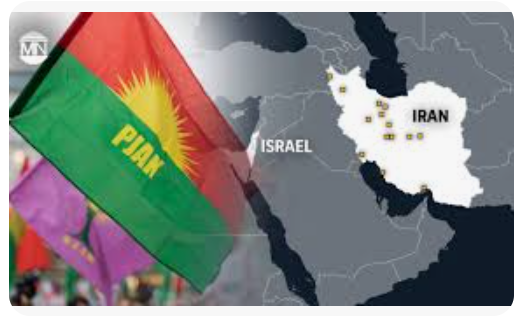
Meanwhile, the PKK’s Iranian branch, PJAK, rejected Öcalan’s call.
Shortly before the Iran war began, PJAK and several other Iranian Kurdish groups formed a joint umbrella organization, apparently seeking to present a united front against Tehran.
President Donald Trump initially encouraged Iranian Kurdish groups to rise up against the Iranian regime, though he later moderated those remarks.
Despite that reversal, Turkish officials remain concerned that mobilizing Kurdish groups could be part of a broader Israeli strategy in the conflict.
“If anything on the Iranian Kurdish front threatens our security, we will respond with force,” one Turkish official said.
Eastern Mediterranean Tensions Intensify
The war has also contributed to new tensions in the Eastern Mediterranean, where Türkiye is already engaged in disputes with Greece and Cyprus over security and energy exploration.
Following a drone attack on a British military base in Cyprus, believed to be carried out by Iran or its proxies, Greece dispatched two frigates and four F-16 fighter jets to the island.
Athens also deployed Patriot air defense missiles to the island of Karpathos near Türkiye’s western coast, citing the need to protect against potential ballistic missile threats.
Türkiye argues that deploying long-range missile systems on Karpathos violates the demilitarized status of the Dodecanese islands.
In response, Ankara deployed fighter jets to ensure the security of the Turkish Republic of Northern Cyprus, the Ankara-backed entity that controls the northern part of the island.
Ankara Seeking De-escalation
Although the war is still in its early stages, it has already created significant economic and security challenges for Türkiye.
US and Israeli officials have suggested the conflict could last several weeks, raising concerns that additional regional actors could become involved.
Turkish officials, however, believe the Iranian regime remains capable of sustaining the conflict for several months.
As a result, Ankara has actively supported diplomatic efforts aimed at de-escalating the conflict and bringing the war to an end.
However, many officials in Türkiye believe their ability to influence the course of events is limited.
According to one Turkish official quoted in the analysis:
“When push comes to shove, Trump listens to Netanyahu — no one else.”
Author: Gönül Tol, Senior Fellow, Middle East Institute (adapted)
PA Turkey intends to inform Turkey watchers with diverse views and opinions. Articles in our website may not necessarily represent the view of our editorial board or count as endorsement.
Follow our English YouTube channel (REAL TURKEY):
https://www.youtube.com/channel/UCKpFJB4GFiNkhmpVZQ_d9Rg
Twitter: @AtillaEng
Facebook: Real Turkey Channel:
https://www.facebook.com/realturkeychannel/
Related articles
Iran War Raises New Concern for Ankara: PKK Enters the Equation
OPINION: Iran’s Weakening Is Turkey’s Opportunity — and Its Trap
OPINION: Türkiye’s Regional Weight Is Quietly Eroding