“You Live in a Dream World”: Senator Graham Lashes Out at Fidan Over Iran and Syria Strategy
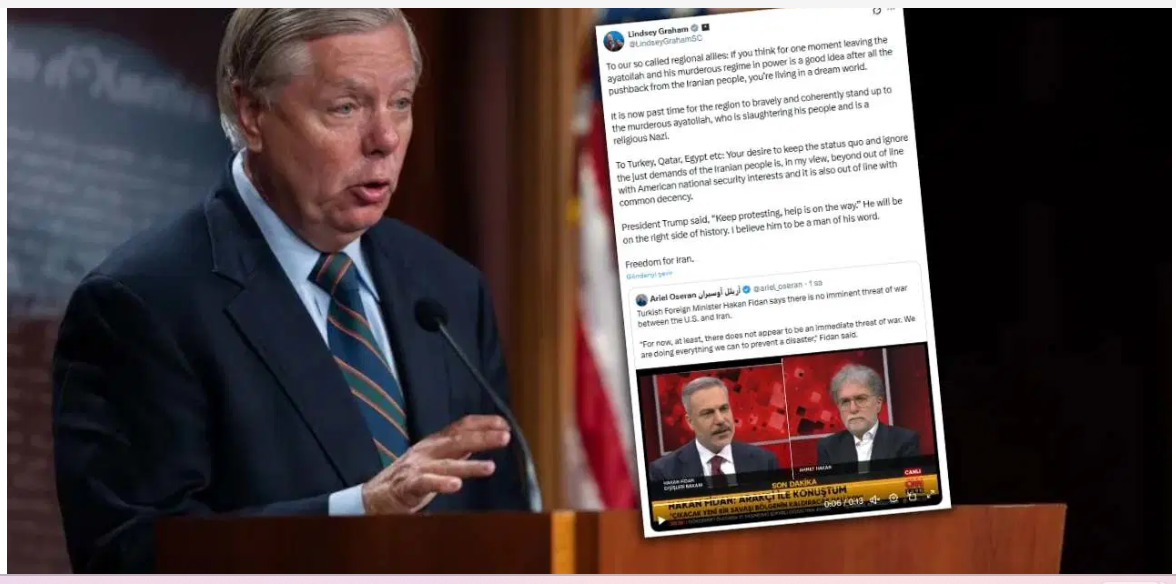 lyndsey graham
The fragile diplomatic detente between Washington and Ankara has hit a new stumbling block as influential Republican Senator Lindsey Graham launched a scathing critique of Turkish Foreign Minister Hakan Fidan. The dispute, which erupted over diverging views on Iran’s regional threat, highlights a deepening rift in the U.S.-Turkey relationship as the Trump administration signals a return to “maximum pressure” tactics in the Middle East.
The Iran Polemic: “Religious Nazis” vs. Diplomacy
The tension began following a televised appearance by Hakan Fidan, where he offered a relatively calm assessment of the Washington-Tehran standoff. Fidan remarked, “The important thing is that dialogue moves away from the threat of war while heading toward a concrete result. At least for now, there seems to be no immediate threat of war.”
Senator Graham’s response was immediate and vitriolic. Quoting Fidan on social media, Graham accused Turkey, along with Qatar and Egypt, of being “so-called regional allies” who are enabling a dangerous status quo.
-
The “Nazi” Comparison: Graham labeled Iranian leader Ali Khamenei a “religious Nazi” and dismissed Fidan’s diplomatic optimism.
-
The Rejection of Status Quo: “If you think leaving the Ayatollah and his murderous regime in power is a good idea, you are living in a dream world,” Graham stated. He argued that maintaining the current regime is fundamentally incompatible with U.S. national security interests and moral standards.
-
The Trump Factor: Graham underscored that the new U.S. administration is on the “right side of history” by supporting Iranian protesters, signaling that “help is on the way” for those seeking regime change.
The “Save the Kurds Act”: A Strategic Flashpoint
While the Iran debate rages on Twitter, the legislative front in D.C. is even more concerning for Ankara. Graham, alongside Senator Richard Blumenthal, has introduced the “Save the Kurds Act.” This bill serves as a direct legislative challenge to Turkey’s regional operations and U.S. disengagement patterns.
“Syria today sits squarely at the most dangerous point in the cycle of disengagement. The Save the Kurds Act reflects a growing recognition that Syria is entering a phase of ideological radicalization and militia entrenchment,” the bill’s background notes.
The Act focuses on several key areas that directly impact Turkey:
-
SDF Protection: It seeks to solidify protections for Kurdish-administered areas (YPG/SDF) in northeastern Syria, which Turkey views as a direct extension of the outlawed PKK.
-
Siege and Pressure Reports: The bill calls for accountability regarding “sieges, road closures, and targeted violence” aimed at undermining Kurdish civilian governance.
-
Constitutional Guarantees: Graham opposes recentralizing power in Damascus without enforceable minority rights, a move that complicates Turkey’s efforts to normalize relations with the Assad regime.
Lindsey Graham: The “Roller Coaster” Ally
Atilla Bey, as we have observed, Graham’s relationship with Turkey is rarely static. He occupies a unique space in the GOP—shifting between a protector of NATO interests and a hawkish critic of Ankara’s autonomy.
| Phase | Key Actions | Impact on Turkey |
| The Defender | Blocked Armenian Genocide resolution (2019). | Provided Ankara a diplomatic shield in D.C. |
| The Critic | Led CAATSA sanctions over S-400 purchase. | Froze Turkey out of the F-35 program. |
| The Watchdog | Co-sponsored F-16 sale conditionality. | Limits the use of U.S. jets in Northern Syria/Aegean. |
Legislative Outlook for 2026
As the 6th High-Level Cooperation Council between Mitsotakis and Erdoğan approaches, Graham’s legislative maneuvers add a layer of complexity. His support for the “Save the Kurds Act” and his alignment with the “Blue Homeland” sanctions framework suggest that any Turkish military move in Syria or the Aegean will face immediate pushback from the Senate.
The “maximum pressure” on Iran favored by Graham likely requires a unified regional front—one that he currently feels Turkey is undermining by prioritizing its own diplomatic channels with Tehran and its military objectives against Kurdish groups.