Can the CHP Mend the Fraught History of the Kurdish Political Movement?
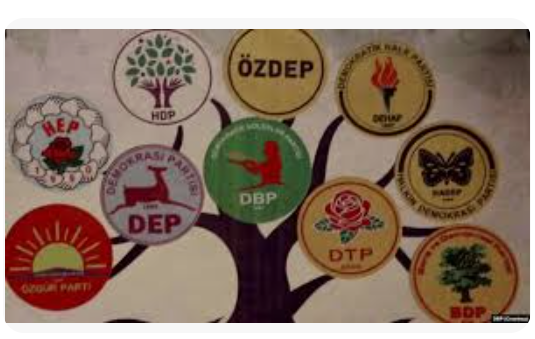 kurt partiler
By Murat Sevinc, Diken
As nationalist rhetoric flares up across Turkey, the main opposition party (CHP) is taking a risky but principled stand. By hosting the “Social Peace and Democracy Conference,” the CHP leadership is signaling a departure from decades of state-mandated silence. Is this a genuine pursuit of a solution, or merely a tactical maneuver?
Navigating the “Kurdish Question” Minefield
In Turkey, social groups are rarely monolithic, yet certain political reflexes remain stubbornly predictable. There is a segment of society that recoils at the mere mention of the phrase “Kurdish issue.” Another, smaller marginal group bristles at the word “Kurd” itself.
The former group is the one that matters for mainstream politics. It ranges from those sincerely trying to understand the complexity of the issue to the “rejectionists” who definitively claim, “There is no Kurdish issue, only a terror issue. Period.” That final “Period!” serves as a psychological barrier, a refusal to engage in the democratic dialogue necessary for a multi-ethnic society.
The history of those who dared to cross this line is a somber one. From the closure of the Workers’ Party of Turkey (TİP) in the 1960s to the 17-year imprisonment of sociologist İsmail Beşikçi for his writings, the state has historically exacted a heavy price from anyone acknowledging Kurdish identity.
A Legacy of Collisions and “The Wall”
For decades, Turkish politics operated under the umbrella of anti-communism, where Kurds and socialists bore the brunt of state pressure. Even after the “communist threat” faded in the 1990s, the security-first approach to the Kurdish issue persisted.
Politicians who tried to bypass the “Wall” of the official ideology—or those who spoke more courageously—eventually crashed into it. While the SHP (Social Democratic Populist Party) opened doors for Kurdish politicians in the early 90s, the result was a cycle of party closures and arrests that continues to this day. The HDP’s closure case remains pending at the Constitutional Court, and its former co-chairs have been behind bars for nearly a decade.
The ruling AKP, after a brief period of “normalization” and peace processes, pivoted sharply back to a nationalist alliance after 2015. Today, we find ourselves in a phase where “brotherhood” rhetoric and exclusionary language swap places overnight, fueled by recent developments in Syria and the resurgence of “secular nationalism.”
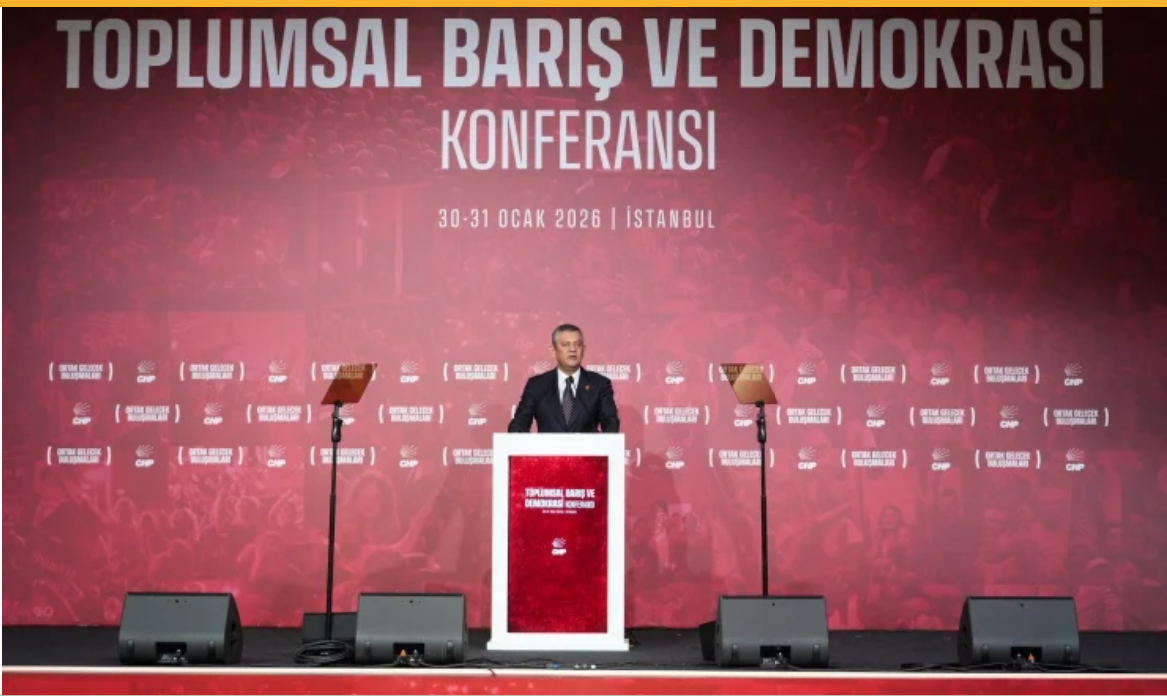
Ozgor Ozel addressing the Peace and Fraternity Gathering
The CHP’s New Stance: More Than Just a Meeting
Against this backdrop of rising radical-discriminatory nationalism, the CHP’s recent “Social Peace and Democracy Conference” held in early February 2026 stands out.
Observers noted a significant shift in political etiquette. Unlike the traditional “grand entrance and exit” of high-level Turkish politicians—who usually arrive with a human circle, speak for ten minutes, and leave before the real discussion begins—CHP Chairman Özgür Özel remained for the duration. He listened to every session, including those on the economic structure of the Kurdish region.
The importance of the meeting was not necessarily in producing binding policy proposals, but in the act of demonstrating that a conversation is possible. At a time when nationalist hysteria is being weaponized, the CHP leadership chose to engage in a civilized, equal, and humane dialogue with representatives of the Kurdish movement and civil society.
Breaking the Cycle
The cynicism surrounding such meetings is predictable. Rumors of “disrespecting the flag” or “nationalist concerns” are often manufactured to derail these efforts. However, the current CHP management appears to be taking a principled stand that transcends mere vote-seeking.
If societies only set problems before themselves that they are capable of solving—as Marx famously suggested—then Turkey’s persistent return to this issue suggests the capacity for a solution is finally maturing. The value of the CHP’s initiative lies in the “insistence on continuing the conversation.” In a landscape where racism is once again finding a voice, the effort to dig a well with a needle—through sincere, face-to-face contact—is perhaps the most revolutionary act currently available in Turkish politics.