Weekly Flow of Funds: Foreign Inflows Persist as Gold Prices Sway Reserves
 para-sirkulasyon
The latest weekly data from the Central Bank of the Republic of Turkey (TCMB) reveals a complex tug-of-war between gold price fluctuations, structural reforms, and a steady appetite from foreign investors. While core reserves excluding swaps saw a slight retreat, the week ending January 30 marked the official “beginning of the end” for the KKM era.
Reserve Dynamics: The “Gold” Factor
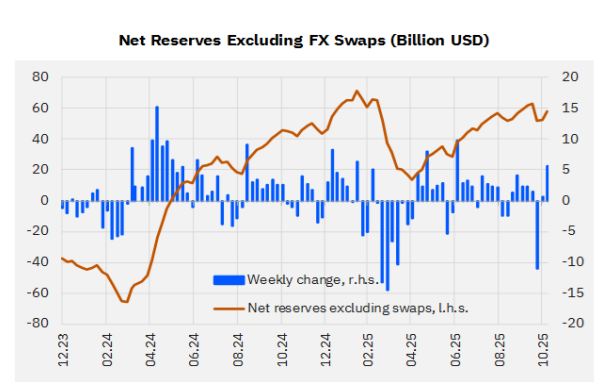
According to TCMB’s analytical balance sheet, the reserve composition is currently being heavily dictated by the volatility in precious metals. Total gross reserves rose by $2.5 billion to reach $218.1 billion as of the week ending January 30. However, net reserves excluding swaps—a key metric for market confidence—dipped by $1.3 billion to $82.1 billion.
When stripping away the “gold price effect,” the decline becomes more pronounced, reaching approximately $5 billion. Projections for the first week of February suggest further pressure, with gross reserves estimated to have fallen by an additional $5.3 billion due to a 2% drop in spot gold prices. Despite these weekly fluctuations, the structural trend for 2026 remains positive; since the start of the year, swap-free net reserves have grown by $18.7 billion, though nearly $13.3 billion of that growth is attributed to gold’s appreciation.
Foreign Investors: Nine Weeks of Uninterrupted Confidence
The “Turkish carry trade” and equity interest remain a bright spot in the data. International investors have now been net buyers of Turkish equities for nine consecutive weeks, bringing the total inflow over this period to $2.3 billion.
-
Government Bonds (DİBS): Foreigners purchased $722 million in bonds during the final week of January, pushing the total year-to-date inflow to $4.2 billion.
-
Equities: An additional $455 million flowed into the stock market, bringing the total stock value of foreign-held equities to $42.4 billion.
The End of KKM: A Milestone in De-dollarization
The TCMB has officially signaled the closure of one of the most significant chapters in recent Turkish economic history. The FX-Protected Deposit (KKM) scheme, which peaked in August 2023, has seen a staggering liquidation of $136.9 billion (3.4 trillion TL). With balances now reduced to negligible levels, the Central Bank has announced that it will cease publishing KKM data starting next week, marking a return to traditional monetary reporting.
Dollarization and Deposit Shifts
Despite the KKM exit, the broader dollarization rate showed a slight uptick, rising from 42.7% to 44% in late January. This shift was largely driven by individual Foreign Currency Deposits (DTH), which grew by $3.2 billion on a parity-adjusted basis, while corporate entities sold $1.3 billion.
Furthermore, the appetite for foreign currency-denominated investment funds is at an all-time high. The active size of all FX funds has reached $81 billion, a massive leap from the $25 billion recorded at the start of 2024.
Related articles
Güldem Atabay: Rate Hikes Are Prozac for Markets, But Toxic for the Real Economy
TURKEY/Weekly Financial Developments: Resilience in Reserves and Strong Foreign Flows

BBVA Research Holds Steady on Turkey’s 2025 Growth Outlook