



Earth’s Crust Is Dripping Beneath Turkey, And Satellites Just Revealed Why
 earth-crust-under-Turkey
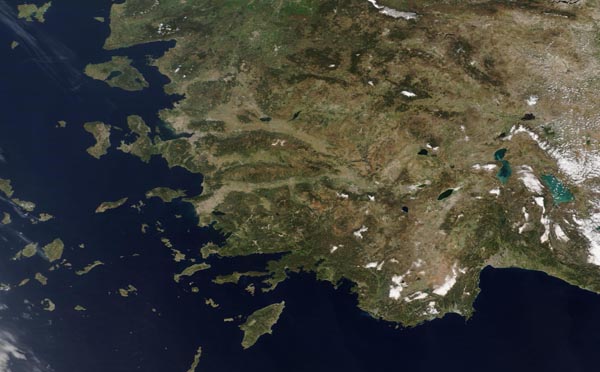
Satellite observations and deep-Earth imaging have uncovered a remarkable geological process beneath Turkey’s Central Anatolian Plateau, specifically under the Konya Basin. Scientists now say that part of Earth’s crust and upper mantle in this region is quite literally “dripping” downward, reshaping the surface above in ways that challenge simple tectonic explanations. This hidden process has fascinated geologists for years, and new research finally explains how a rising plateau can still contain a sinking center
A Rising Plateau With a Sinking Heart
At first glance, the Konya Basin presents a geological paradox. The Central Anatolian Plateau has been uplifting for millions of years, gaining roughly 0.6 miles in elevation over the last 10 million years. Yet right in its middle sits the Konya Basin, a bowl-shaped depression that continues to sink even today. Imagine a tabletop slowly being lifted upward while a shallow dent deepens at its center. Traditional plate tectonics alone cannot easily account for this pattern.
To solve this mystery, a research team from the University of Toronto, led by earth scientist Julia Andersen, combined satellite measurements, seismic imaging, and physical modeling to peer beneath the surface. Their findings, published in Nature Communications, point to a deeper and more dynamic process operating within Earth’s lithosphere.
Plate Tectonics Sets the Stage, But Not the Whole Story
Plate tectonics explains how Earth’s rigid outer shell is broken into massive plates that move atop hotter, softer rock below. These slow movements drive mountain building, earthquakes, and volcanism across the planet. Central Turkey sits in a particularly complex tectonic zone where major plates collide, slide, and reorganize.
While these plate interactions help explain why the Anatolian region is elevated, they do not fully clarify why a nearly circular basin is subsiding within an overall rising plateau. To understand that, scientists had to look deeper than the surface and focus on the behavior of the lower lithosphere and upper mantle.
Multi-Stage Lithospheric Dripping Explained
The research identifies a process known as multi-stage lithospheric dripping. Over time, parts of the lower lithosphere can become denser than the surrounding mantle due to cooling or chemical changes. Once dense enough, gravity pulls this material downward, forming a slow, viscous “drip” that sinks into the mantle.
As this heavy material descends, it tugs on the rock column above it. The surface responds by sagging, forming a basin such as the Konya Basin. Later, if the dense mass fully detaches and sinks deeper into the mantle, the surface can rebound and rise because the excess weight has been removed.
“As the lithosphere thickened and dripped below the region, it formed a basin at the surface that later sprang up when the weight below broke off and sank into the deeper depths of the mantle,” explained co-author Russell Pysklywec.
What makes the Konya Basin especially intriguing is that this was not a single, isolated event. “We now see the process is not a one-time tectonic event and that the initial drip seems to have spawned subsequent daughter events elsewhere in the region, resulting in the curious rapid subsidence of the Konya Basin within the continuously rising plateau of Türkiye,” Pysklywec added.
Satellites and Seismic Waves Reveal the Hidden Process
Modern satellite technology allows scientists to detect tiny vertical movements of Earth’s surface across vast regions. When combined with seismic data from earthquake waves traveling through the planet, researchers can infer what lies deep below.
“Looking at the satellite data, we observed a circular feature at the Konya Basin where the crust is subsiding, or the basin is deepening,” said lead author Julia Andersen. “This prompted us to look at other geophysical data beneath the surface, where we saw a seismic anomaly in the upper mantle and a thickened crust, telling us there is high-density material there and indicating a likely mantle lithospheric drip.”
Together, these datasets painted a consistent picture: dense material beneath the basin is sinking, dragging the surface down with it.
Recreating Earth’s Dripping Crust in the Lab
To test whether this theory could work in practice, the team built laboratory models that mimic Earth’s slow geological processes. Using a plexiglass tank, they layered silicone polymer fluids to represent the mantle, mixed with clay to simulate the upper mantle, and topped it with ceramic and silica spheres to stand in for the crust.
While simplified, these analogue models successfully reproduced the same kinds of instabilities predicted beneath Central Anatolia. Dense layers sagged, formed drip-like structures, and detached, closely matching what the satellite and seismic data suggest is happening deep below Turkey today.
“The findings show these major tectonic events are linked, with one lithospheric drip potentially triggering a host of further activity deep in the planetary interior,” Andersen concluded.
Why Earth’s Dripping Crust Matters Beyond Turkey
The team compared the Konya Basin to similar features, such as the Arizaro Basin in the Andes, showing that lithospheric dripping is not unique to Turkey. Thick crust, intense heat, and complex stresses in high plateaus around the world can all create conditions where dense lower layers begin to sink.
This research also has implications beyond Earth. Mars and Venus lack Earth-style plate tectonics, yet they display massive surface features that hint at internal motion. If dense rock can peel away and sink without plate boundaries, it offers planetary scientists a powerful new way to explain how other worlds evolve from the inside out.