



DEM Party Submits 99-Page Report to Parliament Amid Deep Divisions Over “Terror-Free Türkiye” Process
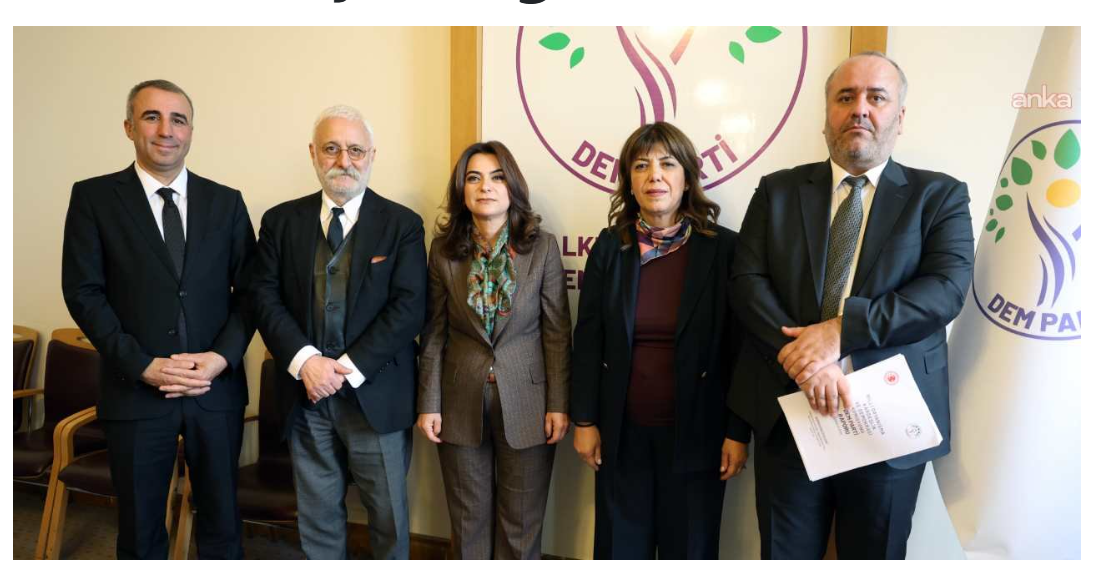 dem parti heyeti
Türkiye’s pro-Kurdish DEM Party has submitted a 99-page report to the Speaker of Parliament as part of the work of the National Solidarity, Brotherhood and Democracy Commission. While other parties are still finalizing their submissions, sharp differences between DEM and its nationalist counterpart MHP over disarmament, legal reforms, and the role of Abdullah Öcalan are emerging as key fault lines in the process.
The DEM Party has formally submitted its long-awaited report to the Turkish Grand National Assembly (TBMM), marking a new stage in parliamentary discussions surrounding the so-called “terror-free Türkiye” initiative.
In a statement released on Monday, DEM Party officials said the 99-page report, prepared by commission members Gülistan Kılıç Koçyiğit, Meral Danış Beştaş, Hakkı Saruhan Oluç, Celal Fırat and Cengiz Çiçek, had been delivered to the office of the Speaker of Parliament. The report has not yet been made public.
According to party sources, the document consists of six sections and includes both analytical assessments and policy recommendations related to peace, disarmament, and democratic reforms.
Other Parties Still Finalizing Reports
The report submissions are part of the work of the National Solidarity, Brotherhood and Democracy Commission, which convened on December 4. At that meeting, political parties briefed commission members on the progress of their reports but did not submit finalized documents.
The CHP submitted a summary report to the Speaker’s office, indicating that a more detailed version would follow. Reports from the ruling AK Party and its nationalist ally MHP are expected later this week. The Yeni Yol Group is also expected to submit its full report by the weekend, while the Yeniden Refah Party has said it needs a few more days to complete its work.
Following the submission of all reports, Parliament Speaker Numan Kurtulmuş is expected either to convene another commission meeting next week or to hold consultations with party coordinators to determine how a final consolidated report will be prepared.
Sharp Differences Between DEM and MHP
Although both MHP and DEM have now submitted reports, political observers note that the two documents reflect fundamentally opposing approaches to the peace and disarmament process.
According to commentary by political analyst Mehmet Tezkan, the DEM Party argues that no distinction should be made between those who have committed crimes and those who have not, and that all individuals should benefit from legal arrangements related to the process.
MHP, by contrast, reportedly insists that only individuals who have not committed crimes should be released under supervised probation, while those involved in violence must face judicial proceedings before benefiting from any sentence reductions.
Öcalan, Syria, and Legal Reforms
One of the most sensitive points of divergence concerns Abdullah Öcalan, the imprisoned PKK leader.
-
DEM is said to call for Öcalan’s immediate release, his direct participation in the process, and the ability to communicate freely with delegations, political actors, and the media.
-
MHP does not openly oppose the possibility of release under the so-called “right to hope,” but reportedly frames it as a final-stage outcome, not a starting point.
Another major fault line concerns northern Syria. DEM’s report reportedly avoids explicit references to the disarmament of the YPG, while MHP insists that all armed structures linked to the PKK, including those in Syria, must be dismantled or integrated into state forces under international supervision.
On legal reforms:
-
DEM advocates for the rapid passage of a “peace law” and broader legislative changes to underpin a democratic settlement.
-
MHP maintains that no legal reforms should take place until all weapons are destroyed, the organization’s armed presence ends in practice, and this is formally confirmed by Turkish intelligence and security institutions.
Democracy vs. Security Debate
Perhaps the most fundamental disagreement lies in how the process is framed.
DEM reportedly views peace as inseparable from democratization, arguing that inequality, polarization, and political stagnation can only be overcome through a peace process intertwined with democratic reforms.
MHP, by contrast, draws a sharp line between the two, insisting that “terror-free Türkiye” and democratization are separate issues and should not be pursued simultaneously.
Political Questions Ahead
The report submission comes shortly after a high-profile visit by a DEM delegation to MHP leader Devlet Bahçeli. Following the meeting, DEM lawmaker Pervin Buldan described the talks as “productive,” while Bahçeli was quoted as saying he would “stand by every word” of her remarks.
That statement has since fueled debate over whether Bahçeli would also endorse the full content of DEM’s report, given the deep differences outlined above.
With parliamentary discussions set to intensify in the coming days, attention is now turning to how — and whether — these sharply divergent positions can be reconciled within a single framework.
PA Turkey intends to inform Turkey watchers with diverse views and opinions. Articles on our website may not necessarily represent the view of our editorial board or count as endorsement.
Follow our English YouTube channel (REAL TURKEY):
https://www.youtube.com/channel/UCKpFJB4GFiNkhmpVZQ_d9Rg
Twitter: @AtillaEng
Facebook: Real Turkey Channel: https://www.facebook.com/realturkeychannel/***
Related articles
DEM Party’s Temelli warns of stagflation, emphasizes democracy for salvation
Turkish military neutralizes 16 terrorists in northern Iraq
Turkish Nationalist Leader Ümit Özdağ Calls for Boycott of Imrali Peace Commission
