



Bahçeli Criticizes CHP and Condemns Pope’s Visit Rituals in Strongly Worded Remarks
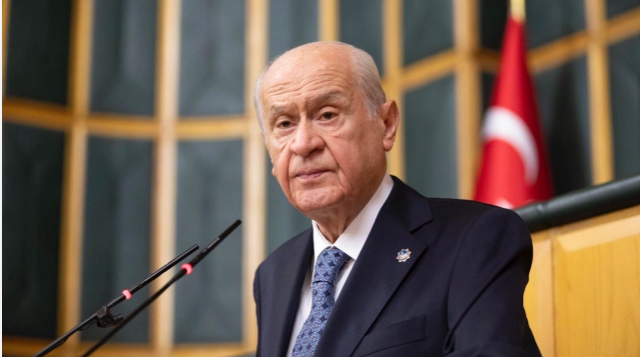 devlet bahceli
Nationalist Movement Party (MHP) Chairman Devlet Bahçeli delivered sharp criticism toward the main opposition Republican People’s Party (CHP), accusing its leadership of failing to take a firm, principled stance on corruption allegations and national security issues. Speaking to Türkgün Newspaper, Bahçeli argued that while calls for political accountability were justified, the CHP’s overall behavior lacked consistency and resolve.
Commenting on ongoing corruption probes involving several municipalities, Bahçeli said, “The call to cleanse administrations from corruption is correct. But the CHP leadership blaming everyone else is not a principled stance. It is essential that the most serious corruption scandal of the century be uncovered and justice delivered.”
Bahçeli also criticized what he described as internal contradictions within the CHP, recalling how former party leader Kemal Kılıçdaroğlu was celebrated emotionally by supporters in the past, only to be sidelined later. He claimed that the party is experiencing confusion across three symbolic fronts—Söğütözü, Saraçhane and Silivri—arguing that the CHP no longer occupies the place in history it once did.
Claims of Avoiding Responsibility in Terror Discussions
The MHP leader directed additional criticism at CHP leadership over their handling of terrorism-related issues. According to Bahçeli, the party refrains from confronting sensitive security topics head-on. He stated that CHP representatives even “avoided going to İmralı,” arguing that this hesitation reflected an unwillingness to engage decisively on one of Turkey’s most pressing matters.
Bahçeli insisted that the CHP is “wrestling evasively” around the country’s counterterrorism agenda, stressing that a clear and determined stance is needed in order to reach a national consensus.
“What Remains From Atatürk?” — Bahçeli Questions CHP’s Ideological Position
Deepening his critique, Bahçeli questioned the CHP’s connection to its founding identity. He asserted that the party has drifted away from the legacy of Mustafa Kemal Atatürk, saying, “They have devastated the party of the revered Atatürk. What have they preserved from him? When have they truly shown respect to the nation, the sole pillar of the Republic?”
Through these remarks, Bahçeli framed the CHP’s current trajectory as incompatible with the historical mission assigned to the party by its founder.
Reaction to Pope’s İznik Visit: “Hidden Messages Are Unacceptable”
Turning to international developments, Bahçeli sharply criticized the religious and ceremonial elements displayed during Pope Francis’ visit to Turkey, especially the symbolic rituals conducted in İznik, historically linked to early Christian councils.
Bahçeli argued that aspects of the visit included “secret propaganda and hidden messages,” adding:
“We cannot stay silent or indifferent to the revival enthusiasm surrounding a council held 1,700 years ago in İznik. There is no point in selling snails in a Muslim neighborhood.”
His remarks reflected concerns within nationalist circles about perceived cultural symbolism and geopolitical implications behind such high-profile religious visits.
Commission on “Terror-Free Turkey” Moves to Next Phase
Bahçeli also commented on the ongoing work of the Parliamentary Commission on National Solidarity, Brotherhood and Democracy, emphasizing that the consultation and hearing stages have concluded. The next step, he said, is the preparation of the final report.
He reiterated his long-standing position that Turkey should decisively move toward a future free from terrorism, asserting that 2026 must mark a turning point in achieving the vision of a “Terror-Free Turkey.”
Strong Message on Gaza: “Perpetrators Must Be Held Accountable”
The MHP leader addressed the situation in Gaza with similarly forceful language, calling for an immediate halt to violence and endorsing a two-state solution as the only viable path forward. Bahçeli reaffirmed his support for the establishment and international recognition of a sovereign Palestinian state with East Jerusalem as its capital, based on the 1967 borders.
He concluded by stressing that those responsible for mass atrocities must face justice, stating, “An independent and territorially unified Palestinian state must be accepted, and the perpetrators of genocide must be held accountable.”