Deutsche Bank: Turkey’s Economy Unlikely to Face a Hard Landing
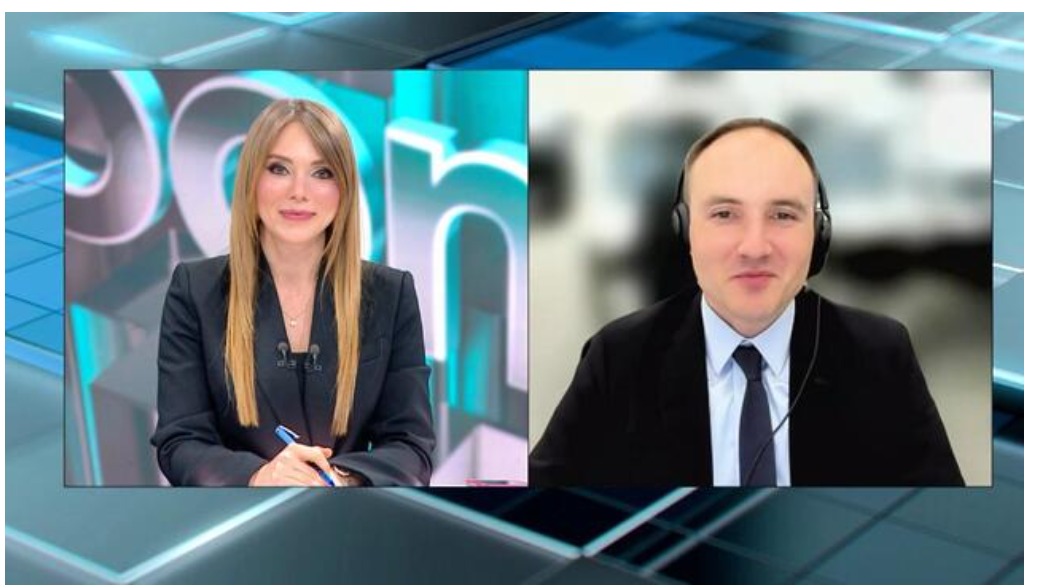 umit onay deutsche
Analyst says TCMB’s latest inflation forecast aims to anchor expectations and avoid premature easing signals
Summary: Deutsche Bank Turkey economist Yiğit Onay said the Central Bank of Turkey’s (TCMB) decision to raise its 2025 inflation forecast range to 31–33% was a deliberate move to curb speculation of early rate cuts. Onay argued that the central bank’s communication strategy, combined with resilient domestic demand, targeted credit support, and external recovery prospects, suggests no major slowdown ahead—even as structural inflation challenges persist.
A Tactical Move to Reinforce Policy Credibility
Speaking to reporters after the release of the TCMB’s latest Inflation Report, Onay described the upward revision as a strategic signal rather than a shift in inflation dynamics.
“Keeping the 2026 target at 16%—which is new and embedded in both the Medium-Term Program (OVP) and investor guidance—was a conscious choice. Raising it now would have sent a dovish message and created the perception of early easing,” he said.
According to Onay, maintaining the 2026 target also serves as a reminder to the Treasury and Finance Ministry to consider inflation expectations in administered price decisions such as energy and public services.
“Adjusting public prices in line with realized inflation distorts expectations,” he added. “The TCMB clearly expects stronger fiscal policy alignment to support disinflation.”
“No Sharp Slowdown Ahead”
Onay said Deutsche Bank does not expect a hard landing in 2025.
He cited several factors supporting growth momentum:
-
A rebound in external demand next year;
-
The supportive impact of targeted credit and incentive programs;
-
Limited need for additional fiscal tightening beyond the current deficit path;
-
The wealth effect created by gains in precious metals and asset markets.
“Barring a negative supply shock, we don’t foresee a sharp cooling in the economy,” Onay noted.
He added that sectoral trends remain uneven: textile and apparel are weakening, while construction, services, high-tech, and defense industries continue to show resilience.
Bond Market Outlook: “Valuations Still Attractive”
Onay highlighted Central Bank Governor Fatih Karahan’s recent remarks on bond portfolio management as a key signal that markets may be underpricing future liquidity conditions.
“In Q2, the TCMB’s securities portfolio-to-balance-sheet ratio approached 3%. It has since declined slightly below 2%, meaning there’s room for expansion,” he said.
He argued that the central bank’s comments encourage the Treasury to focus more on expected inflation when adjusting regulated prices—an approach that indirectly benefits the bond market by stabilizing expectations.
Despite subdued performance since the start of the year, Onay said bond valuations remain appealing when looking forward:
“Weak pricing reflects slower disinflation, uncertainty over the timing of rate cuts, and heavy January borrowing. But from a medium-term perspective, yields still offer value.”
He identified a sustained drop in inflation below 20% as a potential “game-changer” threshold that could shift investor behavior:
“Most investors are still in short-term carry positions. If inflation and FX stability persist, we may see a faster rotation from carry trades to bonds,” Onay added.
Corporate FX Exposure: “Higher, But Manageable”
Onay also assessed the recent increase in non-financial corporates’ net FX short position, which has reached $185 billion.
He acknowledged a rise in exposure but maintained that macro-level risks remain contained.
“FX loans expanded sharply between March 2024 and March 2025, but TCMB’s tighter regulations on foreign-currency lending have since slowed the pace,” he said.
Roughly half of all FX loans are denominated in euros, meaning euro-dollar fluctuations add to currency risk.
Still, the ratio of net FX exposure to GDP is around 12%, down from 25% in 2018.
“The risk is far below past levels and remains manageable,” Onay emphasized.
He cautioned, however, that if corporate borrowing abroad accelerates, the central bank could consider further macroprudential measures to limit systemic vulnerabilities.
PA Turkey intends to inform Turkey watchers with diverse views and opinions. Articles in our website may not necessarily represent the view of our editorial board or count as endorsement.
Follow our English language YouTube videos @ REAL TURKEY: https://www.youtube.com/channel/UCKpFJB4GFiNkhmpVZQ_d9Rg
And content at Twitter: @AtillaEng
Facebook: Real Turkey Channel: https://www.facebook.com/realturkeychannel/***