From Battlefield Commander to White House Guest: Syria’s al-Sharaa Pursues Diplomatic Reset With Washington
 al sara
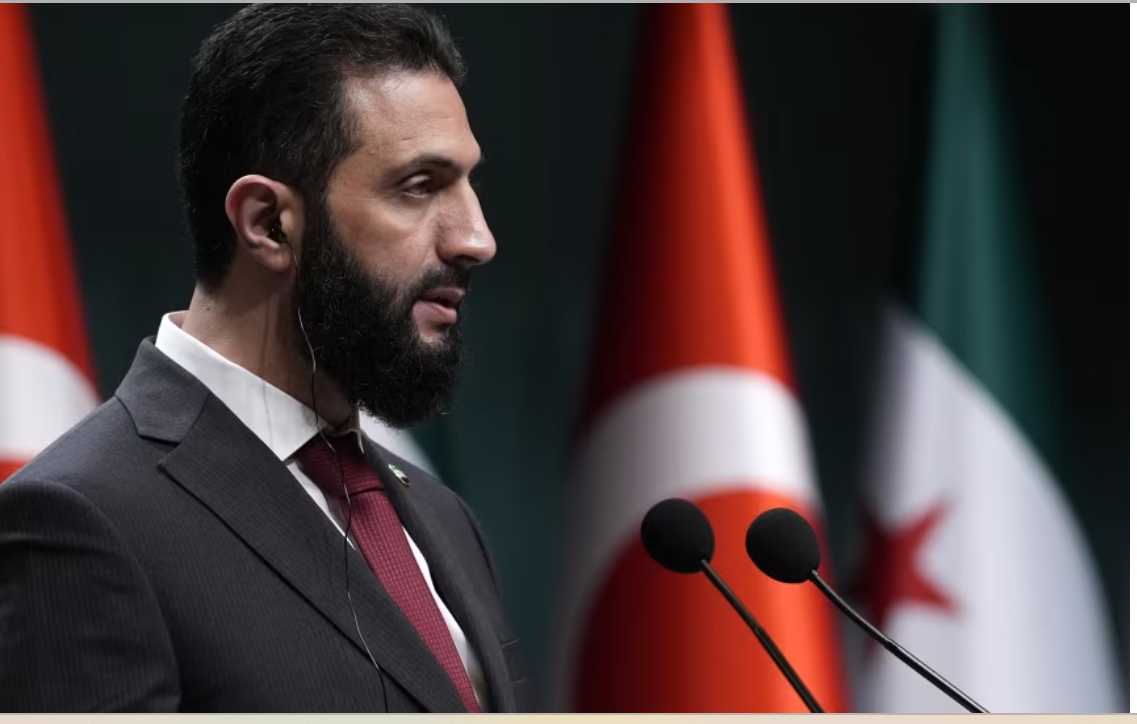
Syrian interim president Ahmad al-Sharaa — once a jihadist commander who fought U.S. forces in Iraq — is making a historic visit to the White House, marking the first time a Syrian head of state has been received in Washington. The visit signals a dramatic shift in both Syria’s international positioning and U.S. regional strategy, with sanctions relief, reconstruction financing, and geopolitical realignment at stake.
A transformation that would have been unthinkable a year ago
Less than twelve months ago, Ahmad al-Sharaa was best known as a guerrilla commander who led an al-Qaeda-backed rebel force against the Assad regime. Before that, he had fought American troops in Iraq, been captured, and eventually crossed into Syria to join the uprising after 2011.
Today, he is walking through the West Wing of the White House.
His meeting with U.S. President Donald Trump — the first-ever White House visit by a Syrian leader — marks his 20th foreign trip since declaring himself interim president in January, part of an aggressive campaign to restore Syria’s diplomatic legitimacy.
Photos released by U.S. officials showing al-Sharaa playing basketball with top American generals upon arrival were not accidental: the symbolism was deliberate. A man who once fought U.S. forces now seeks strategic partnership.
Washington sees an opportunity — and a gamble
Trump first met al-Sharaa in May in a meeting brokered by Saudi Crown Prince Mohammed bin Salman. The U.S. president, impressed by his assertiveness and his ability to end Syria’s decade-long civil war, called him a “young, attractive guy” with a “strong background.” Trump then ordered the removal of certain U.S. sanctions on Syria — a significant gesture toward normalizing relations.
But the hardest sanctions remain in place. Full relief would require Congressional approval, an outcome far from guaranteed.
Al-Sharaa’s objectives in Washington are clear:
-
Push for lifting remaining U.S. sanctions,
-
Seek U.S. pressure on Israel to halt airstrikes in Syria,
-
Negotiate a pathway for foreign investment and reconstruction funds.
For Washington, Syria presents both opportunity and risk. With Lebanon in political and economic collapse, and Iraq influenced heavily by Iran-backed militias, Syria is emerging as the only regional arena where U.S. influence could expand.
“The U.S. is taking a large gamble on Ahmad al-Sharaa and Syria,”
— Joshua Landis, Center for Middle East Studies, University of Oklahoma.
Breaking the Assad era: the geopolitical reset
Al-Sharaa came to power after launching a surprise offensive that toppled Bashar al-Assad, ending the decades-long Assad dynasty — a pillar of Soviet and later Russian influence in the Middle East.
The Assad regime had:
-
Anchored Syria firmly to Moscow,
-
Hosted Russia’s Mediterranean naval base in Tartus since 1971,
-
Relied on Russian airpower to survive the civil war.
Even after Assad’s fall, Russia still operates its military base in Tartus. In October, al-Sharaa visited Moscow and met President Vladimir Putin — a signal of continuity.
Despite his outreach to Washington and European capitals, Al-Sharaa insists on maintaining a balanced foreign policy:
“Engaging in conflict with Russia would be too costly and not in Syria’s interest.”
— al-Sharaa, CBS 60 Minutes, October interview
Saudi Arabia and Turkey push for a regional realignment
Al-Sharaa’s diplomatic comeback is not happening in a vacuum.
According to regional officials, Saudi Arabia and Turkey are actively lobbying Western capitals to support Syria’s new leadership. Their motivations converge:
-
Reduce Iran’s influence in Syria,
-
Reopen trade and reconstruction corridors,
-
Position themselves economically in post-war reconstruction.
Turkey views al-Sharaa as a more predictable interlocutor than the Assad regime, but remains concerned about Kurdish political status in northern Syria. Ankara is pushing Washington to ensure that U.S.–Syria normalization does not evolve into constitutional guarantees for Kurdish autonomy.
A new foreign policy doctrine: “No permanent enemies, no permanent allies”
In international forums, al-Sharaa presents a narrative aligned with an emerging global trend among mid-sized powers: multi-alignment.
-
He engages with the U.S.
-
He maintains ties with Russia.
-
He courts Saudi Arabia and Türkiye.
-
He signals openness to the EU and IMF.
Natasha Hall, senior associate at the Center for Strategic and International Studies (CSIS), describes this strategy as:
“In this era, no country aligns fully with any single pole. Sharaa is positioning Syria between blocs.”
It is a departure from the rigid Cold War-style alignment pursued under the Assad dynasty.
The economic stakes: Syria wants sanctions relief and investment
Syria’s economy is devastated after more than a decade of civil war.
-
GDP has shrunk by more than 70% since 2011,
-
Inflation is out of control,
-
Infrastructure is collapsing,
-
Banking system is isolated from SWIFT and global payments.
Al-Sharaa is presenting a clear deal to foreign governments and investors:
Recognize the new Syria diplomatically → gain access to reconstruction projects.
Saudi Arabia and Gulf sovereign wealth funds have already signaled interest in:
-
Energy infrastructure,
-
Port modernization,
-
Logistics and trade corridors.
Turkey is watching closely, anticipating major economic gains if Western sanctions are lifted.
A symbolic photo with global consequences
The White House visit may not yield immediate policy breakthroughs.
But its symbolic value is enormous.
A man previously sanctioned for terrorism — who once fought American troops — is now shaking hands with the president of the United States.
The implications go beyond optics:
-
It marks the possible reintegration of Syria into the global economy,
-
It challenges Russian and Iranian dominance,
-
It introduces a new regional power dynamic involving Türkiye and Saudi Arabia.
What happens in Washington will echo across the Middle East.
Source: CNN
PA Turkey intends to inform Turkey watchers with diverse views and opinions. Articles on our website may not necessarily represent the view of our editorial board or count as endorsement.
Follow our English language YouTube @ REAL TURKEY and Twitter @AtillaEng.
Related articles
Putin Meets Assad Amidst Efforts to Revive Syria-Turkey Relations
OPINION: Iran’s Weakening Is Turkey’s Opportunity — and Its Trap
National Security Council: Turkey will defend its border no matter the cost