“Torpedo Method” Cocaine Smuggling Emerges in Turkey — Supreme Court Overturns Convictions, Domestic Actors Unquestioned
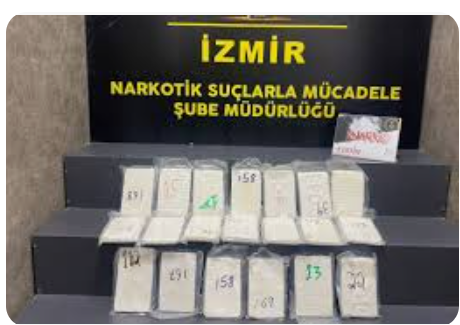 uyuşturucu
A sophisticated cocaine-smuggling technique used by Colombian cartels — known as the “torpedo method” — has surfaced for the first time in Turkey. The case led to the seizure of nearly 28 kilograms of cocaine attached to a cargo ship’s underwater hull, yet the country’s Supreme Court has overturned the convictions of the foreign crew members due to lack of evidence. The ruling also exposes stunning investigative gaps: Turkish authorities did not examine phone records, pursue local suspects, or cooperate with Colombia. Analysts say the case reveals how Turkey has become an emerging transit hub for cocaine shipments routed from Latin America to Europe and the Middle East.
A Hidden Capsule Beneath the Waterline
Court records show that Turkey’s National Police received intelligence on August 22, 2020, that a Panama-flagged coal carrier arriving in Zonguldak from Colombia might be transporting cocaine.
The vessel — owned by Shandong Shipping Corporation and operated by a 20-member Chinese crew — anchored offshore. After an initial inspection found nothing, professional divers discovered a metal hydrodynamic capsule magnetically attached to the hull, below the deck line and invisible from onboard.
Inside the capsule:
-
28 packages
-
27.89 kilograms of cocaine
-
Sealed in plastic, packed to resist pressure and water exposure
The method matches known Colombian cartel practices: attach a drug-filled “torpedo” below the waterline and retrieve it later using divers at the destination port.
Heavy Sentences — Then an Unexpected Reversal
The Zonguldak 3rd High Criminal Court sentenced the captain and first officer to 30 years in prison, arguing that senior crew members must have been aware of the drugs. However:
-
Fingerprints on packaging did not match any crew member
-
Colombian port inspection logs confirmed the hull was clean before departure
-
Prosecutors themselves asked for acquittal at the final hearing
Despite this, appeals courts upheld the convictions — until January 15, 2025.
Turkey’s Supreme Court of Appeals (General Criminal Assembly) reversed the verdict, ruling that:
“No concrete evidence proves the crew’s knowledge or involvement.”
All sentences were suspended, and the defendants were released.
Investigators Ignored Local Suspects
Documents reveal glaring omissions by Turkish authorities:
-
Police failed to analyze HTS/call records of both the ship’s crew and the Turkish maritime agency assisting the vessel.
-
No surveillance was conducted on nearby small craft, despite intelligence predicting a transfer by boat.
-
No attempt was made to identify who was supposed to receive the drugs in Turkey.
-
Turkish authorities did not pursue any judicial or law enforcement cooperation with Colombia.
In effect, the investigation focused solely on the foreign crew, while any potential Turkish facilitators were left untouched.
A Second Case: Same Port, Same Method, Same Year
The Supreme Court ruling cites a nearly identical case tried in Çanakkale in November 2021 involving another ship departing the same Colombian port (Drummond) only weeks apart — again with a magnetically attached cocaine capsule.
Two cases, identical methods, same origin.
Yet in both:
-
No Turkish intermediaries were identified
-
No follow-up arrests were made
Turkey’s Expanding Role in the Global Cocaine Trade
Drug seizures at Turkish ports — including Mersin, İzmir, İskenderun, and Zonguldak — have surged over the last three years. Former narcotics officials and analysts argue that Turkey is increasingly functioning as a cocaine transit hub, facilitated by:
-
Politically protected shipping interests
-
Weak port inspections
-
Selective law enforcement targeting only non-Turkish actors
While authorities frequently publicize quantities seized, they rarely dismantle the networks behind them.
“The system shows the kilos, protects the network,”
say critics familiar with narcotics investigations.
Symbolic Victory, Systemic Failure
The Supreme Court’s decision is a procedural win for the defendants — yet it exposes Turkey’s troubling reality:
-
Major cocaine seizures
-
No domestic prosecution
-
No financial tracking
-
No accountability
The cocaine wasn’t the only thing hidden underwater.
So was the truth about who benefits from Turkey’s emerging role in the trade.
Source: Nordic Monitor
Related articles

Pro-AKP journalist: “If allegations are true, a trustee will be appointed to Istanbul Municipality”

Turkish Pop Star Hande Yener Under Investigation for “Targeting Constitutional Order”

ANALYSIS: Imamoglu Indictment Seen as Political Move Targeting CHP Leadership