



A Tiny “Second Moon”? Asteroid 2025 PN7 Has Been Shadowing Earth for Decades
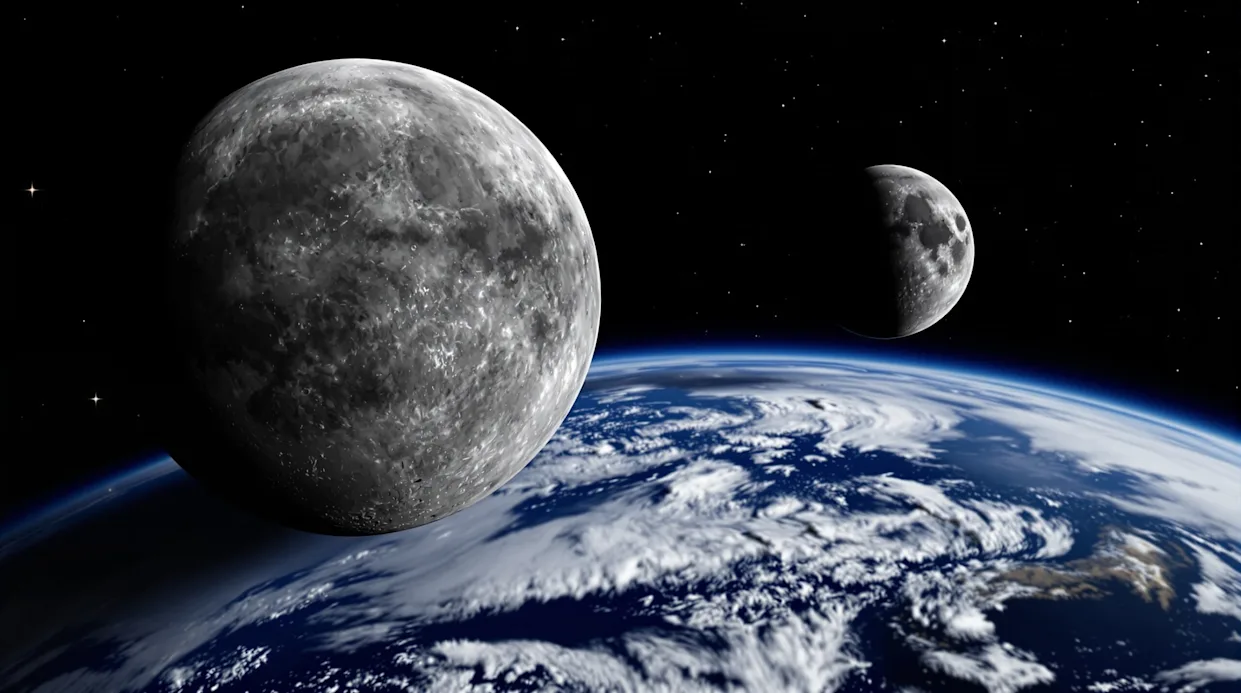 2025 PN7
Astronomers have identified a small asteroid named 2025 PN7 that has been traveling almost in sync with Earth’s orbit for decades — earning it the nickname of a “semi-moon” or “quasi-satellite.”
Dr. Jenifer Millard from Fifth Star Labs in Wales explained to BBC that while these objects appear to orbit Earth, they are not true moons:
“Quasi-satellites don’t orbit a planet like the Moon does — they just happen to stay nearby.”
A 20-Meter Companion Discovered in Hawaii
Measuring roughly 20 meters in length, the asteroid was detected by the Pan-STARRS Observatory in Hawaii — a facility known for discovering near-Earth objects (NEOs).
Dr. Millard noted that 2025 PN7 has likely been accompanying Earth for about 60 years and may continue to do so for another six decades.
“It’s been following us for decades, and it will probably remain for decades more,” she said.
Earth’s Hidden Companions: Quasi-Moons, Mini-Moons, and Ghost Moons
Scientists currently know of eight quasi-satellites, several mini-moons, and possibly two “ghost moons” orbiting in Earth’s vicinity — though none are gravitationally bound like our actual Moon.
-
Quasi-Moons:
These asteroids appear to orbit Earth but actually revolve around the Sun, subtly influenced by Earth’s gravity. -
Mini-Moons:
Small asteroids temporarily captured by Earth’s gravity, often staying in orbit for less than a year. The most recent, 2024 PT5, was observed in August 2024. -
Ghost Moons:
Theoretical dust clouds trailing Earth’s orbit — sometimes referred to as Kordylewski clouds — which remain unconfirmed by direct observation.
“They Pose No Threat,” Experts Reassure
Despite their proximity, Dr. Millard emphasized that these cosmic companions are no danger to Earth:
“They’re several times farther away than the Moon. Even if they drift closer, their motion is so slow that we’d have plenty of time to react.”
Beyond Earth: Other Planets Have Quasi-Satellites Too
Thanks to advances in telescopes and data analysis, astronomers have identified similar quasi-satellites orbiting Jupiter, Venus, Saturn, Neptune, and Pluto.
Dr. Millard summed it up:
“The solar system is still very much alive and dynamic — everything is constantly in motion. There’s still so much left to discover.”