Germany Signals Eurofighter Delivery, Support for Customs Union Renewal
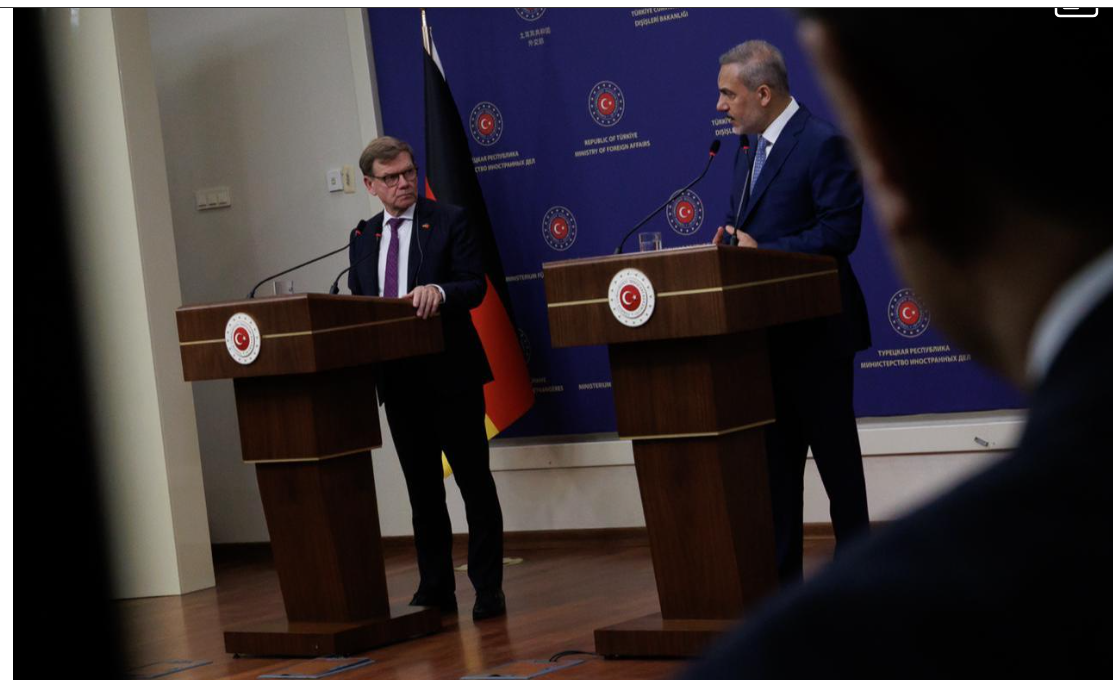 hakan fidan- wadephul
Summary:
German Foreign Minister Johann Wadephul announced that Eurofighter Typhoon fighter jet deliveries to Türkiye could begin within 2025, but stressed that shipments cannot proceed until a formal agreement is signed. His comments followed high-level meetings in Ankara, where both sides reaffirmed their commitment to NATO cooperation, European defense integration, and regional stability — including Türkiye’s potential participation in the EU’s SAFE defense initiative.
“Delivery Possible This Year — But Signature Required”
Following his talks with Turkish Foreign Minister Hakan Fidan in Ankara, Germany’s top diplomat Johann Wadephul told Turkish broadcaster NTV that progress on the Eurofighter Typhoon sale was advancing rapidly.
“I believe this will happen in a short time — perhaps even this year,” Wadephul said. “The Eurofighter has been in production for many years, and capacity has been expanded. But before any delivery, we need a signed agreement. Work is ongoing on that.”
Wadephul emphasized that the decision to finalize and deliver the aircraft ultimately rests with the manufacturing companies, but signaled that Berlin views the transaction positively.
“We see the delivery of these aircraft as a natural step between allies,” he said.
NATO Context: “Türkiye Is a Reliable Ally”
Reaffirming Germany’s commitment to Türkiye’s defense capabilities, Wadephul said:
“We recognize Türkiye as a reliable NATO ally, and we want to strengthen our joint defense cooperation. Sending Eurofighters to Türkiye is entirely natural for us.”
He stressed that the aircraft would contribute to alliance-wide defense, including that of Greece, and framed the move within the broader context of Russian aggression in Europe.
“We must defend the alliance together. From that perspective, this delivery is a positive step,” Wadephul said.
Türkiye’s Eurofighter Ambition
Türkiye aims to acquire around 40 Eurofighter Typhoon jets, following an agreement signed on July 23, 2025, between Ankara and the United Kingdom during the 17th International Defense Industry Fair (IDEF) in Istanbul.
The memorandum of understanding (MoU) was signed by Turkish Defense Minister Yaşar Güler and UK Defense Secretary John Healey, after Germany’s Security Council approved the sale.
“We plan to procure approximately 40 aircraft — there are multiple options, and we are working on them,” Güler said during the ceremony.
Initially, Ankara had sought to buy 40 F-16V aircraft and upgrade 79 existing F-16s from the United States. However, delays and political obstacles in Washington prompted Türkiye to pivot toward the Eurofighter consortium, co-produced by the UK, Germany, Spain, and Italy.
Berlin Backs Türkiye’s Inclusion in Europe’s SAFE Defense Initiative
Germany also reaffirmed its support for Türkiye’s participation in the European defense initiative SAFE, a project aimed at deepening industrial and technological cooperation among EU and NATO partners.
“Türkiye is a reliable and important NATO ally,” Wadephul said. “We oppose any restrictions on arms sales or defense cooperation with Ankara. With whom else should we cooperate, if not our NATO partners?”
The talks in Ankara covered Türkiye–EU relations, the Gaza peace process, and Russia’s war in Ukraine. Wadephul emphasized that from Berlin’s standpoint, there are “no limitations” on defense cooperation within the alliance.
Turkish Foreign Minister Hakan Fidan described Türkiye’s potential inclusion in SAFE as “a step of critical importance,” urging the EU to “move beyond the narrow political calculations of some of its members.”
“Türkiye and Germany share a commitment to European security,” Fidan said. “We welcome Germany’s constructive approach and aim to strengthen our joint defense projects under the SAFE mechanism.”
“Türkiye Is Not Just an Ally — A Strategic Partner and a Friend”
At a joint press conference, Wadephul characterized Türkiye as a vital partner beyond NATO’s military dimension:
“Türkiye is not only a NATO ally but also a strategic partner and a good friend in all our foreign policy matters — and it will continue to be so.”
He also praised Türkiye’s contribution to the U.S.-brokered Gaza peace plan, calling Ankara’s role “highly valuable.”
“I am confident that Türkiye will continue to support efforts to turn the Gaza agreement into a genuine peace process,” Wadephul said, reaffirming Germany’s backing of a two-state solution.
A Renewed Push in EU–Türkiye Relations
Looking ahead, Wadephul said Germany wants to advance cooperation between the EU and Türkiye, similar to existing EU–NATO coordination frameworks.
“We want progress in EU–Türkiye relations. We want to update the customs union, achieve visa liberalization, and pursue a generally positive agenda,” he said. “If Türkiye truly wishes to join the EU, it will find a reliable and friendly partner in Germany.”
He cautioned, however, that progress on democracy, human rights, and the rule of law remains essential for Türkiye’s EU accession process.
“The path will not be easy, and it cannot be completed in weeks or months,” Wadephul added.
Despite ongoing differences, both ministers underscored their shared interest in regional stability, defense cooperation, and transatlantic security.
“We value Türkiye’s partnership,” Wadephul concluded. “Our countries stand side by side — for NATO, for Europe, and for peace.”