



Erdoğan at UN: Calls for Gaza Ceasefire, Microphone Cut Sparks Debate
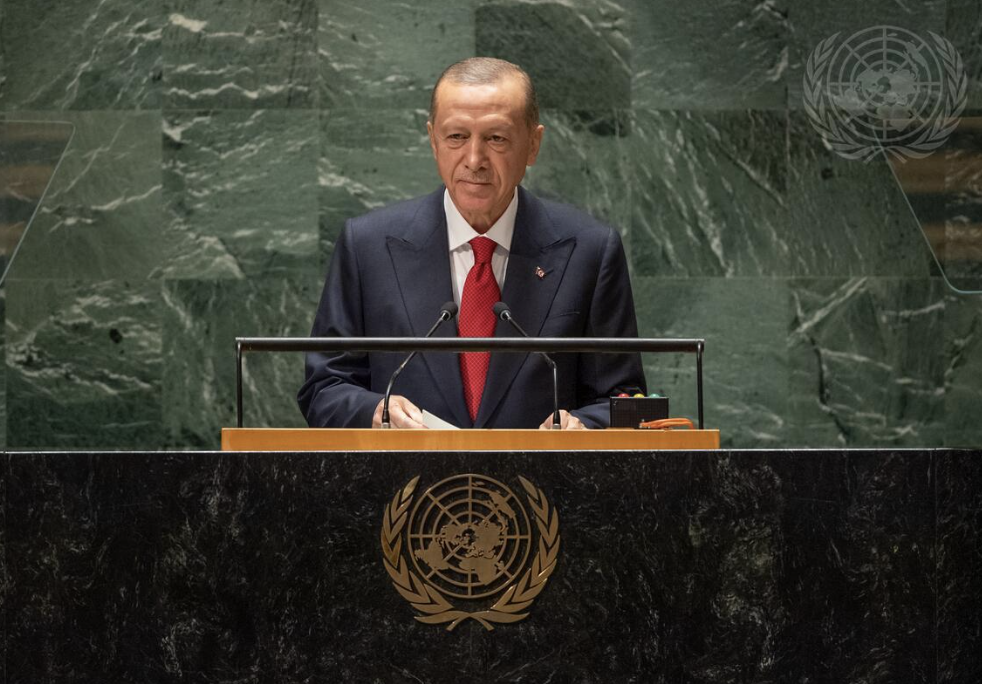 Erdogan UN speech
Turkish President Recep Tayyip Erdoğan delivered a forceful speech at a United Nations conference on the Palestinian question, urging an immediate ceasefire in Gaza and the withdrawal of Israeli forces. Yet, midway through his address, his microphone went silent — a moment that quickly ignited speculation on social media.
While some claimed Erdoğan’s words had been deliberately cut, Turkey’s Directorate of Communications clarified that the incident stemmed not from censorship, but from the five-minute speaking limit applied to all heads of state.
Ceasefire, Humanitarian Access, Withdrawal
Speaking at the conference titled “Finding a Solution to the Palestine Question”, Erdoğan condemned Israel’s ongoing military operations in Gaza, which he said have created an unprecedented humanitarian disaster.
“Artık ateşkesin ilanı, Gazze’ye insani yardımların engelsiz şekilde girişinin sağlanması ve İsrail’in Gazze’den güçlerini çekmesi gerekiyor,” he declared.
Erdoğan described the international recognition of Palestine by several countries as a “historic” development, and called on the global community to meet both its legal and moral responsibilities.
“The Palestinian Cause Belongs to the World”
In his address, Erdoğan painted a grim picture of the toll in Gaza, citing tens of thousands of deaths. He accused the Israeli government of attempting to eradicate the two-state solution, force Palestinians into displacement, and expand illegal settlements in the West Bank and East Jerusalem.
“Bugün Filistin davası artık dünyaya mal olmuştur. Bu salondaki katılım bunun en güzel ispatıdır,” he said, noting that worldwide protests, media coverage, and grassroots movements have elevated the Palestinian cause onto the global stage.
Drawing a controversial parallel, Erdoğan claimed that a government once representing a people nearly annihilated in the Holocaust is now itself imposing suffering on its neighbors:
“Holocaust zulmüyle kökü kazınmak istenen bir toplumu yöneten Netanyahu hükümeti aynı toprağı, suyu, havayı, denizi paylaştığı binlerce yıllık komşularına soykırım uyguluyor.”
Microphone Shuts Off Mid-Speech
The moment that drew the most attention, however, was technical — or procedural. As Erdoğan continued past the allotted time, his microphone was cut off. A translator on the broadcast remarked: “Başkanın sesini kaybettik, kimse onu duyamıyor” (“We lost the President’s voice, no one can hear him”).
Clips of the moment spread rapidly online, with the hashtag “Erdoğan’ın sesi kesildi” trending across Turkish social media. Some commentators accused organizers of silencing him, while others pointed to procedural rules.
Directorate of Communications Responds
Turkey’s Directorate of Communications quickly issued a statement, emphasizing that the incident was not politically motivated.
“Devlet ve Hükümet Başkanlarının konuşmaları için 5 dakika süre öngörülmüştür. Sayın Cumhurbaşkanımızın konuşması da bu çerçevede sınırlı tutulmuştur. Sürenin dolmasıyla mikrofon otomatik olarak kapanmıştır. Aynı uygulama Endonezya Cumhurbaşkanının konuşmasında da gerçekleşmiştir.”
The office underlined that Erdoğan’s remarks nonetheless contained “messages that shape the global agenda.”
Reactions in the Hall
Despite the microphone issue, Erdoğan continued delivering his speech to the end. Following his address, French President Emmanuel Macron thanked him, acknowledging Turkey’s role in keeping the Palestinian question on the international agenda.
A Global Stage, A Local Debate
The episode highlighted the symbolic power of international platforms like the UN. While Erdoğan used the stage to frame Gaza as a test of global conscience and international law, the microphone cut gave the speech an additional layer of controversy — one that resonated far beyond diplomatic circles.
As debates swirl over whether it was a procedural matter or a political slight, one point remains clear: Turkey’s leadership is determined to keep the Palestinian issue at the center of world diplomacy.