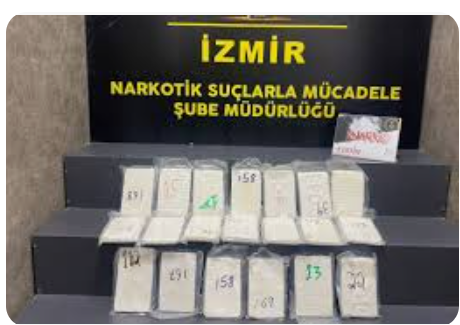
Massive Cocaine Bust at Turkish Border Involving Diplomatic SUV: A Deepening Crisis in Turkey’s Role in Global Drug Trade
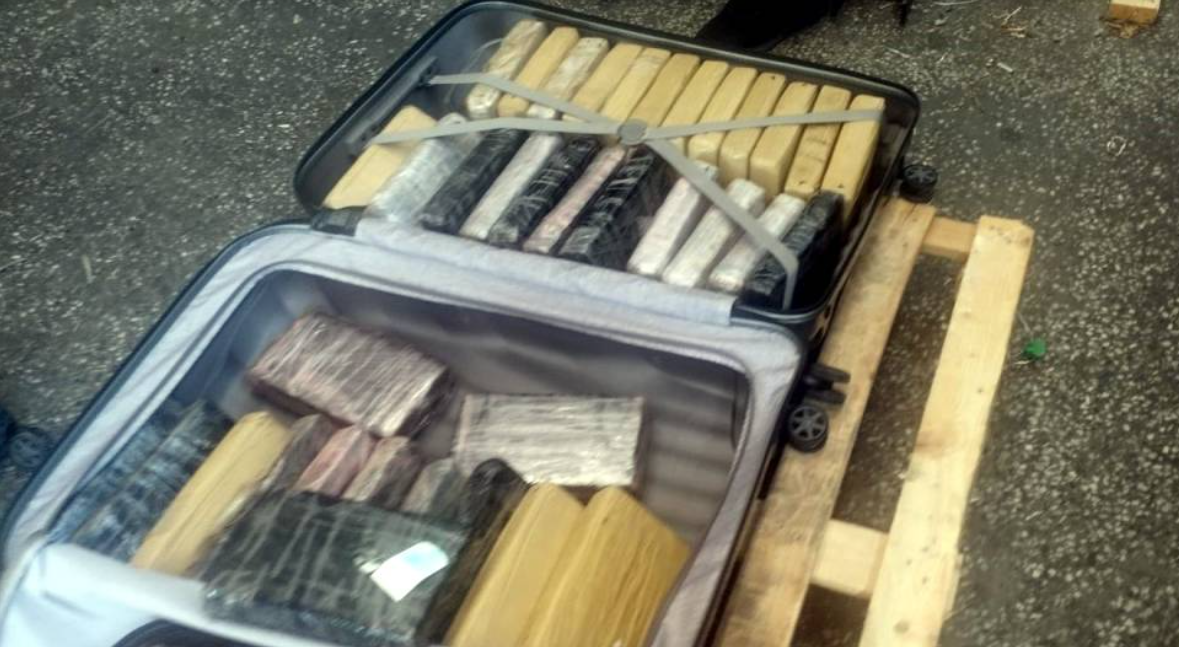 kokain
Summary:
Bulgarian authorities have seized over 205 kilograms of cocaine from a diplomatic-plated SUV attempting to enter Turkey, triggering a high-profile investigation and renewed scrutiny over Turkey’s role in the international narcotics trade. The operation, dubbed “Orient Express,” comes amid rising concerns over Turkish trafficking networks and recent domestic scandals involving political figures.
Cocaine Hidden in Diplomatic Vehicle Intercepted at Bulgaria-Turkey Border
On July 18, Bulgarian authorities at the Kapitan Andreevo Border Gate, a key crossing into Turkey, seized 205.945 kilograms of cocaine concealed inside suitcases in a diplomatic-plated SUV. The vehicle was flagged and searched during an operation named “Orient Express”.
According to the Bulgarian Interior Ministry, the SUV had entered Bulgaria from Serbia and was being driven by a 43-year-old Bulgarian national, D.H. On board were Zh.M., a 40-year-old Congolese national with a diplomatic passport, and D.A., a 54-year-old Belgian citizen born in the Republic of Congo. Upon reaching the Turkish border, the vehicle was stopped and scanned with an x-ray machine. A narcotics dog named Raya aided the search, which revealed suspicious density in the luggage.
Upon inspection, authorities discovered 179 packets of cocaine, with an estimated street value of 37 million Bulgarian lev (approximately $21 million USD). All three individuals were arrested at the scene.
High-Level Bulgarian Officials Confirm Operation Details
Following the seizure, a press conference was held by Bulgarian Finance Minister Temenuzhka Petkova, Interior Minister Daniel Mitov, Customs Director Georgi Dimov, Narcotics Division Chief Commissioner Boyan Raev, and Haskovo District Prosecutor Ivan Stoyanov. The suspects face charges of attempting to smuggle high-risk narcotics across the Bulgarian-Turkish border without proper clearance.
Turkey’s Evolving Role in Global Drug Trafficking
While Turkey has long been seen as a transit route in the global drug supply chain, recent data and arrests point to a more central role in narcotics trafficking. The 2022 report by Turkey’s Narcotics Department revealed that the country now functions both as a target and transit nation for illicit drugs, particularly cocaine and heroin.
Cocaine shipments from South American countries like Colombia, Peru, and Bolivia are increasingly routed through Turkey en route to European markets. The ports of Mersin and İzmir have emerged as hotspots for large-scale drug interceptions.
In fact, the European Monitoring Centre for Drugs and Drug Addiction (EMCDDA) previously confirmed through wastewater analysis that drug use had penetrated even mid-sized Anatolian towns, not just major cities.
Political Scandals and Allegations of Official Complicity
Despite government claims of success in combating narcotics, recent incidents have raised serious concerns over political involvement in the drug trade.
Notably, Ahmet Zenbilci, an AKP Member of Parliament from Adana, faced a scandal when 20 kilograms of narcotics were discovered in a vehicle registered to him, driven by his son, T.Z. The younger Zenbilci was arrested and charged with drug trafficking.
Additionally, a major operation dubbed “Bataklık” (The Swamp), once hailed by former Interior Minister Süleyman Soylu as the largest in Turkey’s history, ended with none of the 73 accused—including alleged ringleaders Çetin Gören and Nejat Daş—remaining in custody.
Turkey’s Trafficking Infrastructure: A Journalist’s Perspective
In an interview with journalist Cengiz Erdinç, a longtime observer of narcotics in Turkey, he explained how Turkish smugglers gained control of regional heroin and cocaine networks:
“Turkey wasn’t just a pass-through country. Since the 1970s, local heroin consumption has surged. Turkish traffickers now dominate the European heroin market, and have gained significant ground in the cocaine trade through exchanges with South American networks.”
According to Erdinç, even though Turkey doesn’t produce narcotics, it has become a hub due to its strategic position and powerful smuggling syndicates. He also criticized the lack of effective anti-money laundering laws and insufficient coordination among law enforcement agencies.
Cocaine’s Exploding Value in Turkey
Data from Europol estimates the annual value of the EU cocaine market at $12.6 billion. As for Turkey, 2024 has already seen 9 tons of cocaine seized abroad in operations linked to Turkish networks.
Inside Turkey, cocaine prices are soaring. As of June 2024, the street price in Istanbul reached 3,000 TL ($90) per gram, with purity affecting final cost. That places the estimated annual cocaine traffic through Turkey at between $2.9 billion and $5.8 billion, underscoring its critical importance to global supply chains.
Government Denial and Legislative Roadblocks
While Interior Minister Ali Yerlikaya frequently shares drug bust statistics on social media, real reform faces political resistance. A 2022 parliamentary proposal to investigate the political links of drug trafficking was rejected by AKP and MHP votes, further fueling skepticism about the government’s commitment to eradicating the problem.
IMPORTANT DISCLOSURE: PA Turkey intends to inform Turkey watchers with diverse views and opinions. Articles in our website may not necessarily represent the view of our editorial board or count as endorsement.
Follow our English language YouTube videos @ REAL TURKEY: https://www.youtube.com/channel/UCKpFJB4GFiNkhmpVZQ_d9Rg
And content at Twitter: @AtillaEng
Facebook: Real Turkey Channel: https://www.facebook.com/realturkeychannel/